Every operations manager in Dubai knows the feeling. The racks are full, containers are queuing at the gate, and the forklift you thought was enough is suddenly the bottleneck.
Peak inventory season doesn’t arrive as a surprise. It arrives on a calendar. What catches people out is how much equipment the peak demands compared with the rest of the year. This guide walks through when Dubai’s peaks hit, why renting beats buying for them, which machines earn their place, and the rules to keep in mind.
Dubai’s Peak Calendar Is Longer Than You Think
Most businesses plan around one big sale. In Dubai, the pressure comes in waves.
- Late November: UAE sales run longer than the global Black Friday date. They often start a week or more before it and continue into early December. Black Friday itself lands on 27 November this year, so stock needs to be in place well before that.
- 4 December 2026 to 17 January 2027: The 32nd Dubai Shopping Festival runs for 45 days across the city.
- Early February 2027: Ramadan is expected to begin around then, subject to moon sighting, and it brings its own retail surge.
- April 2027: Dubai’s Department of Economy and Tourism announced a new 10-day Electronics Festival.
The Department of Economy and Tourism also lists Ramadan, the Shopping Festival, Back-to-School and Black Friday as the periods that keep driving consumer demand. Online growth adds to it: UAE e-commerce kept expanding in the first half of 2026 even while online retail across the wider Gulf contracted.
For a warehouse, that means inbound stock lands weeks before each event, then outbound volume spikes. You need extra lifting and handling capacity for a few weeks, not for the year.
Why Buying for the Peak Rarely Makes Sense
Space is tight in Dubai, and equipment is just as hard to justify when it sits idle.
Knight Frank’s H1 2026 review found manufacturing and industry made up 35.1% of new space requirements in Dubai. Demand for facilities above 100,000 sq ft also climbed sharply. Cushman & Wakefield put Grade A occupancy across the UAE at around 95%, and Cavendish Maxwell recorded Dubai warehouse rents up 17.6% in 2025, with Jebel Ali rising 22.1%.
When space is scarce and costly, you can’t spread out to handle a spike. You work the space you have harder, which means faster turnaround, more vertical storage and more machine-hours. Buying that capacity outright ties up cash in assets you use for six weeks. Renting lets you scale up for the surge and hand the machines back when it ends.
The Equipment That Actually Earns Its Place
Forklifts. The obvious one. Extra units keep receiving, putaway and dispatch running in parallel instead of in a queue. Match the type to the floor: electric for indoor, quieter work, diesel for yards and outdoor loading.
Scissor lifts. Useful for overhead racking work, temporary shelving, lighting, and decorating retail floors before a festival. They go straight up and carry people plus materials on a stable platform.
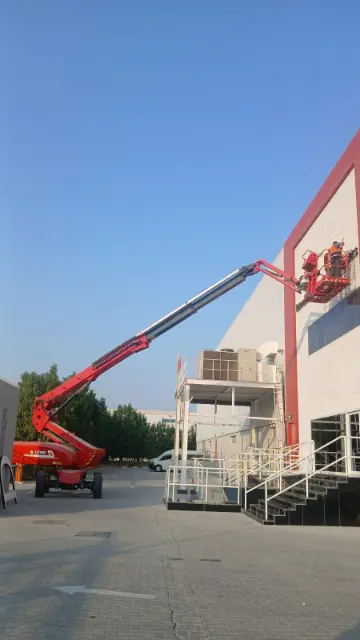
Boom lifts. When you need to reach over or around obstacles, such as high-bay racking, rooftop signage, facade banners or ductwork above machinery, an articulated or telescopic boom does what a scissor lift can’t. Our guide to boom lift rental in Dubai covers how to choose between them.
Boom loaders and mobile cranes. For heavy or oversized deliveries such as machinery, containers and large fixtures, lifting equipment saves hours at the gate.
The best approach is to hire for the bottleneck, not for everything. Map your peak workflow, find where goods wait the longest, and put equipment there first.
The Rules That Apply (and Are Easy to Overlook)
Renting doesn’t pass the compliance burden to someone else. Your site still has to meet Dubai standards.
Forklifts. Dubai Municipality published a Safe Forklift Operations technical guideline in 2026 that applies to warehouses, factories and distribution centres. It covers traffic management plans, vehicle technology, safe working practices and operator training, with the aim of keeping pedestrians and operators clear of forklift accidents. A follow-up circular asks industrial facilities to put the measures in place, so check the compliance deadline directly with the municipality.
Lifting equipment. Dubai Municipality’s guideline on examination and certification of cranes, hoists, lifts and other lifting equipment applies to all establishments using such equipment in the emirate. Ask your rental partner for current inspection and certification documents before any machine is delivered.
Working at height. The municipality’s MEWP guideline applies to every establishment using mobile elevated work platforms in Dubai. It centres on a risk-assessed safe system of work. Industry sources note it expects operators trained to ISO 18878, the standard IPAF courses follow. Don’t hand a scissor lift or boom lift to someone without the right training.
Summer peaks. If your busy period falls in August for back-to-school stock, remember the UAE midday work ban applies from 15 June to 15 September. Outdoor work in direct sunlight stops from 12:30 to 3:00 PM, with fines of AED 5,000 per worker. Outdoor loading yards need schedules built around it.
If your site sits in a free zone, confirm whether Dubai Municipality or the free zone authority is your regulator.
A Simple Peak-Season Equipment Timeline
8 weeks out: Review last year’s peak. Where did queues form? Which machines were overworked or idle?
6 weeks out: Reserve equipment. Peak-season availability tightens, and the choice narrows the later you ask.
4 weeks out: Confirm operator arrangements and training records. Ask whether operators are supplied or you bring your own, and make sure everyone is certified for the machine type.
2 weeks out: Walk the site. Check aisle widths, floor loading, charging points for electric machines, and pedestrian routes.
Delivery week: Inspect on arrival, run a pre-use check, and brief your team.
After the peak: Release equipment promptly and review what worked.
Common Mistakes to Avoid
- Booking late and taking whatever is left
- Hiring machines but not checking operator certification
- Ignoring pedestrian separation in crowded peak-season aisles
- Choosing diesel for a sealed indoor space without proper ventilation
- Forgetting charging infrastructure for electric fleets
- Keeping hired equipment longer than needed because returning it feels like a hassle
What to Look for in a Rental Partner
Peak season is when partnership matters most. You want a supplier who answers quickly, delivers when promised, provides documentation without chasing, and can swap a machine fast if something fails.
If you’re planning your next surge, the team at Up Way Transport can help you match equipment to your site, schedule and workflow, whether you need a few extra forklifts for six weeks or access equipment for a seasonal fit-out.
Final Thought
Peak season rewards the businesses that prepare quietly, weeks before the crowds arrive. Temporary equipment is how you do it: capacity when you need it, without owning it when you don’t. Plan the timeline, check the rules, and start the conversation early.