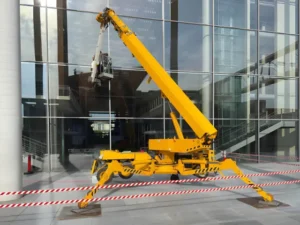
A spider crane is a practical option when a construction project needs to lift heavy materials in a space that is too restricted for a conventional mobile crane. Its compact crawler chassis, telescopic boom and stabilising outriggers can make it suitable for indoor construction, glass installation, machinery positioning and lifting work in confined areas.
However, a compact crane is not automatically suitable for every restricted-access site. The correct choice depends on the load’s weight, the lifting radius, the required hook height, the available access route, the outrigger footprint and the strength of the supporting ground or floor.
For contractors, MEP engineers, glazing specialists and project managers considering spider crane rental in Dubai, the most important step is to assess the complete lifting task before selecting a machine. Upway Transport LLC lists spider crane models including the URW095, URW245, URW295, URW376, URW506, URW547, URW706 and URW1006 in its equipment services information. The precise model, configuration and availability should be confirmed against the project’s requirements before booking.
This guide explains when a spider crane is appropriate, how to assess its lifting capabilities, what to check before delivery and when a different type of crane may be the better option.
What Is a Spider Crane?
A spider crane is a compact lifting machine that typically travels on crawler tracks and uses extendable stabilising outriggers to support lifting operations. The outriggers resemble spider legs, which is where the machine gets its name.
Unlike an aerial work platform, a spider crane is designed to lift and position materials using a hook, hoist and boom. It is not designed to carry workers on a platform for routine access work.
Spider cranes are also called mini crawler cranes or mini spider cranes. Depending on the model and attachments, they can lift materials such as glass panels, steel components, mechanical equipment and construction materials in locations where larger cranes have difficulty gaining access.
Their compact design can be particularly useful inside buildings, behind existing structures and in narrow working areas. However, the crane still needs sufficient room to travel, deploy its outriggers and operate within its approved lifting configuration.
When Should You Use a Spider Crane?
A spider crane is worth considering when the lifting task requires a combination of compact access, controlled material handling and a relatively small operating footprint.
- Glass and façade installation
Spider cranes can help position glazing units, curtain-wall components and other materials that need to be lifted carefully into place. The required lifting capacity must be checked at the actual working radius, including the weight of any lifting frame or glass-handling attachment.
- Indoor construction and fit-out
A suitably sized crane may help move heavy materials inside commercial buildings, industrial facilities or large interior spaces where external crane access is impractical. Floor loading, headroom, route clearance and the outrigger setup must be assessed first.
Mechanical, electrical and plumbing projects may require equipment, pumps, motors, duct components or other heavy items to be positioned in restricted areas. A spider crane can be useful when the load needs to pass through a narrow access route before being lifted into its final position.
Where walls, columns, existing equipment or neighbouring structures limit the space available to a crane, a compact model may offer a workable alternative. The available setup area and lifting radius still determine whether the intended lift is feasible.
A spider crane is not necessarily the best solution if the load is beyond its rated capacity, the boom cannot reach the required position, the outriggers cannot be deployed safely or the access route cannot accommodate the machine. In those situations, the lifting plan should be reassessed rather than relying on the crane’s headline capacity.
Spider Crane Applications in Dubai Construction Projects
Dubai construction projects can involve high-rise buildings, commercial fit-outs, industrial facilities, façade installations and equipment replacement in operational buildings. These environments may create lifting challenges where conventional crane positioning is difficult.
Common applications include:
- Glass installation: positioning glass panels and façade components at designated installation points.
- Mechanical plant replacement: moving pumps, motors and other equipment into plant rooms or service areas.
- Steel installation: positioning steel sections or structural components where access is limited.
- Indoor refurbishment: handling heavy materials inside commercial properties and industrial buildings.
- Industrial maintenance: lifting equipment and components around existing machinery or fixed structures.
- Building services installation: positioning selected HVAC and other MEP components where the load, reach and access conditions are suitable.
These are general applications of spider cranes, not claims that Upway has completed each type of project. The suitability of a particular crane must be established from the actual load, configuration and site conditions.
Spider Crane for Confined Spaces and Indoor Lifting
A spider crane can be a strong candidate for confined-space lifting, but the phrase confined space should not be interpreted as meaning that every narrow area is accessible.
Before selecting a mini spider crane, assess three separate requirements.
Access to the work area: Can the crane pass through the entrance, corridor, doorway, goods lift or temporary opening? Measure the narrowest point along the entire route, including turns, ramps and changes in floor level.
Space to set up: Can the crane deploy its outriggers in an approved configuration without obstructing emergency exits, striking nearby structures or placing excessive loads on adjacent surfaces?
Space to complete the lift: Can the boom, hook and suspended load move through the intended lifting path without contacting ceilings, columns, cables, pipework or other obstructions?
For indoor projects, electric operation may be an option on certain models. However, the available power configuration must be confirmed for the actual machine. Electric operation does not remove the need to check floor capacity, ventilation requirements for any accompanying power unit, access clearances and site safety controls.
Is a spider crane suitable for glass installation in Dubai?
A spider crane may be suitable for glass installation where the crane can reach the installation point and the lifting configuration accommodates the panel’s weight and dimensions. The assessment should include the glass-handling attachment, the panel’s centre of gravity, wind exposure where relevant, the required working radius and the permitted load for that configuration.
Glass installation often involves large surface areas and loads that are sensitive to movement. The lifting arrangement, attachment compatibility and load-control procedures must therefore be confirmed before work starts.
For high-level façade work, also distinguish between lifting a glass panel into position and providing access for the installers. A spider crane performs the lifting task; a spider lift or another suitable access platform may be needed separately for workers to complete installation activities.
Spider Crane Lifting Capacity: What the Rated Load Really Means
A spider crane’s maximum rated capacity is not the weight it can lift at every boom position. Its permitted load depends on the working radius, boom extension, boom angle, outrigger configuration, hook arrangement and the manufacturer’s load chart.
The working radius is the horizontal distance between the crane’s centre of rotation and the vertical lifting line of the suspended load. As the radius increases, the permitted lifting capacity commonly decreases.
For example, the UNIC URW-095 manufacturer’s information lists a maximum rated load of 995 kg at a 3.5 m radius. That specification does not mean the crane can lift 995 kg at its maximum working radius of 8.41 m. The approved load chart must be checked for the exact setup and lifting position.
When calculating the required capacity, account for the complete suspended load, including applicable lifting accessories and attachments as required by the manufacturer’s instructions and the lifting plan.
| What to check | Why it matters |
| Load weight | Establishes the mass that must be lifted, including relevant lifting accessories. |
| Working radius | Determines the permitted load at the planned lifting position. |
| Boom configuration | Changes the available reach and permitted capacity. |
| Hook and reeving arrangement | Can affect the rated capacity and lifting configuration. |
| Outrigger position | The selected setup must match an approved load-chart configuration. |
| Load dimensions and centre of gravity | Affect clearance, balance and load-control requirements. |
| Ground or floor support | Must safely accommodate the crane’s reactions and imposed loads. |
Never select a spider crane based solely on a statement such as “three-tonne capacity”. Ask for the relevant load chart and check the rated capacity at the actual radius and height required for the lift.
Spider Crane Lifting Height and Reach
Lifting height and horizontal reach are different measurements. A crane may be able to lift a load to a particular height when positioned close to the load, but it may have a much lower permitted capacity when the load must be moved farther away horizontally.
The three measurements to establish are:
- Hook height: the height the hook needs to reach for the lift.
- Working radius: the horizontal distance from the crane’s centre of rotation to the load’s lifting line.
- Boom configuration: the boom extension, angle and any permitted jib or attachment arrangement needed to reach the load.
The UNIC URW-095, for example, has a published maximum lifting height of 8.8 m and a maximum working radius of 8.41 m. Those are separate maximum figures; they should not be interpreted as a guarantee that the crane can lift the required load at both limits simultaneously.
For a project involving a plant room, mezzanine, atrium or façade, provide a drawing or site measurements showing the crane position, load pick-up point and final placement point. This gives the rental provider a clearer basis for checking the required configuration.
Spider Crane Site Access Requirements
A compact crane may pass through a narrow opening but still be unsuitable for the job once it reaches the work area. Access planning must consider the machine’s complete route and its operating footprint.
Before arranging spider crane hire in Dubai, confirm the following:
- The narrowest doorway, gate or corridor width and height.
- Available turning space and route length.
- Floor transitions, ramps, thresholds and changes in level.
- Any weight restrictions on goods lifts, access bridges or suspended slabs.
- The space needed to deploy outriggers and operate the boom.
- Overhead obstructions, nearby structures and underground services.
- Delivery, unloading and transport arrangements.
- Building management permissions and any site-specific work restrictions.
The crane’s travel dimensions are not the same as its operating dimensions. A machine that fits through a doorway may need a substantially larger area to stabilise and lift.
Site-readiness checklist
Before the crane arrives
- Confirm the load weight and dimensions.
- Measure the complete access route.
- Confirm required hook height and working radius.
- Identify the available crane setup and outrigger area.
- Obtain floor or ground loading information.
- Check overhead obstructions and underground services.
- Confirm delivery, unloading and site permissions.
- Arrange the required lifting plan, inspections and competent personnel.
- Reset checklistCopy checklist
This checklist is an initial planning aid, not a substitute for a site assessment, lift plan or the machine manufacturer’s operating instructions.
Spider Crane Ground and Floor Requirements
The supporting surface is one of the most important considerations when selecting a spider crane, particularly for indoor lifting.
Spider cranes use outriggers to stabilise the machine during lifting. These supports transfer loads to the ground or floor, creating localised reactions that may be significantly different from the machine’s average weight divided by its overall footprint.
A floor that appears solid may not be suitable for the proposed setup. Raised access floors, suspended slabs, basements, ramps, paving and underground utility zones require particular attention.
Before the lift, the responsible team should establish:
- Whether the ground or structure can support the machine and the loads imposed by the selected outrigger configuration.
- The allowable bearing pressure or support requirements for the actual setup, based on appropriate technical information.
- Whether correctly specified outrigger mats or other load-distribution measures are needed.
- Whether the surface is level and suitable for the manufacturer’s permitted operating conditions.
- Whether underground services, voids, trenches, slab edges or nearby excavations could affect stability.
Do not assume that rubber crawler tracks or protective mats automatically make a crane suitable for delicate flooring or weak slabs. Track pressure during travel and outrigger reactions during lifting are different considerations. Where structural capacity is uncertain, obtain an appropriate assessment before proceeding.
Spider Crane vs Mobile Crane
A spider crane and a conventional mobile crane serve overlapping but different lifting needs. The right choice depends on the complete lifting task rather than the machine’s size alone.
| Decision factor | Spider crane | Conventional mobile crane |
| Access | Often advantageous in narrow access routes, depending on model | Often requires more room for access and positioning |
| Setup | Compact chassis, but still needs a suitable outrigger footprint | Requires an appropriate setup area and stabilisation |
| Lifting capacity | Varies by model, radius and configuration | Wide range of capacities, including heavy-lift options |
| Indoor work | Can suit selected indoor tasks when floor, headroom and power conditions allow | Suitability depends on building access, dimensions, emissions and structural capacity |
| Large outdoor lifts | Appropriate for selected loads and restricted sites | Often more suitable when greater capacity or reach is required |
| Transport and positioning | Compact models can be easier to route through restricted areas | Transport and positioning requirements vary with crane type |
A spider crane may be preferable when a conventional mobile crane cannot reach the work area or cannot be positioned efficiently. A larger mobile crane may be more appropriate when the lift requires greater capacity, a longer radius or a configuration unavailable from a mini crawler crane.
Neither machine should be selected without verifying the load chart and site conditions.
Spider Crane vs Mini Crane: Is There a Difference?
The terms spider crane and mini crane are often used interchangeably, but mini crane is a broader description.
A spider crane is typically a compact crawler crane with stabilising outriggers. Other mini cranes may use different chassis, stabilisation systems or lifting arrangements. Some are designed primarily for indoor use, while others are configured for outdoor work or specialised lifting tasks.
When comparing rental options, check the manufacturer’s model designation and technical documentation rather than relying on the equipment’s marketing name. Confirm the actual lifting mechanism, transport dimensions, operating footprint, power source, capacity and approved working configurations.
It is also important not to confuse a spider crane with a spider lift. A spider lift is an elevated work platform designed to position workers and tools at height. A spider crane is a material-lifting machine. Upway’s existing service pages cover both categories, so customers should specify whether they need to lift materials, provide access for workers or arrange both operations.
Factors Affecting Spider Crane Rental Cost in Dubai
The cost of spider crane rental in Dubai depends on the machine required, the lifting task and the conditions at the project site. An accurate quotation requires more information than the load’s weight alone.
The main cost factors include:
- Crane model and capacity: A crane with greater capacity, reach or specialised features may have different rental charges.
- Rental duration: Daily, weekly and monthly arrangements may be priced differently.
- Delivery and collection: Distance, transport arrangements, access restrictions and unloading requirements can affect the total cost.
- Operator requirements: Confirm whether the quotation includes an operator and any other personnel required for the planned lift.
- Attachments and configuration: Specialised hooks, jibs or lifting accessories may affect suitability and cost.
- Site preparation: Additional assessment, floor protection, access arrangements or other preparation may be necessary.
- Lifting complexity: Restricted access, multiple lifting positions and coordination with other site activities can affect the work required.
For a useful quotation, provide the project location, expected rental period, load weight and dimensions, required lifting height, working radius and site access details. Include any known floor restrictions and explain whether the crane will operate indoors or outdoors.
Upway Transport lists flexible daily, weekly and monthly equipment rental arrangements in its service information. Confirm the specific terms, equipment availability, delivery charges and any operator arrangements directly with the company.
How to Choose the Right Spider Crane for Your Project
The most suitable spider crane is the smallest machine that can safely complete the planned lift within the manufacturer’s permitted operating conditions. A smaller machine is not automatically cheaper overall if it cannot reach the load or requires a different lifting arrangement.
Use the following selection process.
- Define the load. Record the load’s weight, dimensions, centre of gravity and lifting points. Include the relevant weight of the lifting accessories and attachments.
- Map the lifting path. Identify where the load will be picked up, where it must be placed and any obstructions along the route. Establish the required hook height and working radius.
- Measure access and setup space. Check the access route, overhead clearance, turning space and available area for the outriggers.
- Verify the load chart. Check that the proposed model can handle the required load at the intended radius, boom configuration and outrigger position.
- Confirm the site conditions. Establish the suitability of the supporting surface, any building restrictions and the arrangements needed for safe delivery and operation.
- Confirm the rental arrangement. Agree on the model, configuration, rental period, transport, operator provision and required documentation before booking.
What information should you provide when requesting a quotation?
A useful enquiry should contain:
| Information | What to provide |
| Project location | Site address or project area in Dubai or elsewhere in the UAE |
| Application | Glass installation, machinery positioning, steelwork or another lifting task |
| Load | Weight, dimensions and lifting points |
| Required reach | Hook height and horizontal working radius |
| Access | Doorway dimensions, route restrictions and available setup area |
| Ground or floor | Known load limits, surface type and any structural restrictions |
| Rental period | Expected start date and duration |
| Support | Whether an operator, lifting accessories or additional services are required |
If you do not have all the technical measurements, share the available drawings, photographs and site information. The missing details can then be identified before a final equipment recommendation is made.
Safety Considerations for Spider Crane Hire in Dubai
Compact lifting equipment still presents serious risks if it is overloaded, incorrectly configured or operated on an unsuitable surface. Restricted access can also make it harder to keep people away from the lifting area and maintain clear communication.
The Dubai Development Authority’s Circular 614, dated 14 March 2025, states that lifting equipment used at construction sites must be inspected and certified by companies accredited by the Emirates International Accreditation Centre (EIAC). It also specifies certification requirements for personnel involved in lifting operations, regular maintenance in accordance with manufacturer recommendations and the maintenance of on-site records. Applicability should be checked against the relevant project and authority requirements.
Before starting a lift, the project team should confirm the applicable requirements for:
- Equipment inspection, certification and maintenance records.
- A suitable lifting plan and risk assessment.
- Competent and appropriately certified personnel.
- Correct crane configuration and compliance with the manufacturer’s load chart.
- Ground bearing capacity, outrigger support and stability.
- Exclusion zones, load control and communication arrangements.
- Overhead power lines, underground services and other site hazards.
- Weather and wind limits specified by the manufacturer and the approved lifting plan.
An operator’s presence does not remove the need for appropriate planning and supervision. The responsibilities of the crane operator, lifting supervisor, rigger, signaler and other personnel should be established for the particular operation.
For projects in Dubai, confirm the applicable authority requirements, site rules and documentation with the responsible project team before arranging the equipment.
Frequently Asked Questions
What is a spider crane used for?
A spider crane is used to lift and position materials in locations where conventional cranes may have difficulty accessing or operating. Typical applications include glass installation, steelwork, machinery positioning, indoor construction and selected industrial maintenance tasks.
Can a spider crane operate inside a building?
Yes, some spider cranes are suitable for indoor lifting. Suitability depends on the machine’s dimensions, access route, required lifting configuration, floor capacity, headroom and power source. Indoor use should be confirmed for the specific model and site.
How much weight can a spider crane lift?
Lifting capacity varies by model and configuration. For example, the UNIC URW-095 is rated at 995 kg at a 3.5 m working radius, according to its published technical information. The permitted capacity at another radius may be lower, so the relevant manufacturer load chart must always be checked.
How high can a spider crane lift?
The maximum lifting height depends on the model and its configuration. The UNIC URW-095 has a published maximum lifting height of 8.8 m, while other spider crane models offer different lifting ranges. Maximum height alone does not establish whether a crane can lift a particular load safely at that height.
Is a spider crane suitable for glass installation in Dubai?
It can be suitable when the crane’s capacity, reach, lifting attachment and access conditions match the glazing task. The glass dimensions, weight, wind exposure, installation position and surrounding obstructions must be assessed before selecting the machine.
What is the difference between a spider crane and a spider lift?
A spider crane lifts materials using a hook and lifting mechanism. A spider lift is an aerial work platform designed to raise workers and tools. The two machines serve different purposes, although a project may require both.
How much does spider crane rental cost in Dubai?
The cost depends on the crane model, required lifting capacity, rental period, transport, attachments, operator arrangements and site conditions. Request a quotation based on the actual lifting task rather than a generic capacity requirement.
What should I check before hiring a spider crane?
Confirm the load weight, required lifting height and radius, machine access dimensions, outrigger footprint, supporting surface, load chart, rental period and necessary safety documentation. These details help establish whether a particular model is suitable for the project.
Arrange Spider Crane Rental for Your Project
Choosing the right crane begins with understanding the lift, not simply selecting a machine with a suitable headline capacity. The load, lifting radius, required height, access route, outrigger configuration and supporting surface all affect the final decision.
Upway Transport LLC provides construction and lifting equipment rental services in Dubai and across the UAE. To discuss a spider crane requirement, contact the team with your project location, load details, required reach, site access information and expected rental period.
Contact Upway Transport LLC
- Phone: +971 56 881 9292
- Email: sale@upwaytransport.ae
- Website: Upway Transport LLC
Ask the team to confirm the appropriate crane model, its availability and the technical information needed to assess the proposed lift before booking.