

What Contractors Should Prepare Before a Mobile Crane Arrives on Site
Before a mobile crane arrives at a construction site, contractors should have the lift requirements defined, the crane position and access route checked, the ground assessed, the required approvals arranged, and the lifting team briefed. The site must be ready not only for the crane to enter, but also for it to set up safely, lift the intended load, and leave without disrupting other operations.
For projects in Dubai and across the UAE, preparation should begin with five essentials: load details, crane positioning, ground-bearing capacity, access and overhead clearances, and lifting documentation. The exact requirements depend on the load, crane configuration, site conditions, project procedures, and applicable authority requirements.
A crane should not be selected simply because its advertised lifting capacity appears greater than the load weight. Its permitted capacity depends on the lifting radius, boom configuration, counterweight, outrigger arrangement, and other conditions specified by the manufacturer. The site must also support the loads transferred through the crane’s outriggers.
Upway Transport LLC provides mobile crane rental in Dubai and across the UAE for construction, industrial and infrastructure applications. Preparing the information below before requesting or confirming a rental helps the project team assess the required crane and identify potential site constraints before mobilization.
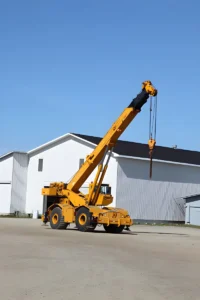
1. Confirm exactly what needs to be lifted
The first preparation step is to establish what the crane will lift, where the load will be collected, and where it must be placed.
Do not rely on a general description such as “lift an air-conditioning unit to the roof” or “move steel beams into position.” The lifting team needs enough information to assess the load, rigging arrangement, crane position, and intended lifting path.
Prepare the following details:
- Load description: Identify the equipment, structural component, material bundle, or other item to be lifted.
- Verified weight: Obtain the manufacturer’s weight, delivery documentation, or another reliable source. Include any attachments or components that will be lifted with it.
- Dimensions: Record the load’s length, width, and height, particularly where it may be difficult to manoeuvre.
- Centre of gravity: Establish how the load’s weight is distributed and where it can be safely supported.
- Lifting points: Confirm the designated lifting points and any restrictions specified by the manufacturer or responsible engineer.
- Pick-up and landing locations: Identify where the load starts, where it will be placed and whether either location has restricted access.
- Rigging requirements: Determine the appropriate slings, shackles, lifting beams or other accessories, subject to the lifting plan and the load’s characteristics.
If the weight is uncertain, resolve that uncertainty before finalising the crane selection. An underestimated load can invalidate the planned lifting arrangement.
Also consider the rigging and lifting accessories when establishing the gross suspended load. The relevant crane load chart and lift plan determine how the load and applicable deductions must be accounted for.
2. Determine the required lifting radius and crane configuration
A crane’s nominal capacity is not the same as its capacity at every working position.
The lifting radius is the horizontal distance from the crane’s centre of rotation to the load’s vertical lifting line. As the radius increases, the crane’s permitted lifting capacity generally decreases, subject to the particular crane and configuration.
Before arranging the crane, establish:
- The crane’s proposed set-up position.
- The distance from its centre of rotation to the load at pick-up.
- The maximum radius during the lifting and slewing movement.
- The boom length and configuration required.
- The height and position at which the load must be landed.
- The available space for the crane’s outriggers and counterweight, where applicable.
The crane must be checked against the manufacturer’s load chart for the actual configuration and the most demanding part of the lift. A load that can be lifted close to the crane may exceed the permitted capacity when the crane is positioned farther away to clear a building or obstruction.
What information should you give the rental provider?
Provide the load weight, maximum working radius, required lifting height, pick-up and landing locations, and any restrictions affecting crane positioning.
These details help establish the appropriate crane category and configuration. They are more useful than requesting a crane by tonnage alone.
Upway’s mobile crane rental service is the relevant commercial starting point for discussing the lifting requirement. The exact crane model, capacity and availability should be confirmed for the specific job rather than inferred from a general service description.
3. Make sure the ground can support the crane
Ground preparation is one of the most important parts of mobile crane planning. A surface that looks solid may still be unsuitable for the concentrated loads transmitted through the crane’s outriggers.
Outriggers are the extendable supports used to stabilise many mobile cranes during lifting. Their reactions—the forces they transfer into the supporting surface—can be substantial and vary with the load, boom position and crane configuration.
The contractor must arrange an appropriate assessment of the supporting ground and any platform or temporary works beneath the crane.
What should be checked?
| Ground or site condition | What needs to be established |
| Compacted soil or fill | Whether the supporting ground has adequate bearing capacity for the planned crane loads |
| Concrete slabs or suspended floors | Whether the structure can safely support the crane and its concentrated outrigger reactions |
| Underground basements or voids | Whether concealed spaces could be affected by the crane’s loading |
| Buried utilities and drainage | Whether services or trenches could be affected by the crane position or support loads |
| Recently excavated ground | Whether excavation edges or disturbed soil could compromise support |
| Uneven or sloping surfaces | Whether a suitable set-up position and required crane levelling can be achieved |
| Existing roads or paved areas | Whether the pavement structure and underlying ground can support the proposed loading |
What are outrigger mats, and when are they needed?
Outrigger mats or suitable engineered support systems spread concentrated loads over a larger area. Their purpose is to keep the pressure applied to the ground within the ground’s assessed capacity.
The required mat size and arrangement should be based on the relevant outrigger reactions, allowable ground-bearing pressure, and the properties of the supporting surface. A larger mat is not automatically adequate if the ground is weak, the mat is unsuitable or the support arrangement is incorrectly designed.
Do not position the crane near an excavation, underground structure, or suspended slab without confirming that the proposed setup has been assessed appropriately.
For complex or uncertain conditions, the contractor may need a competent geotechnical or structural assessment and an engineered crane platform or support arrangement before the crane is mobilized.
The crane operator and lifting team must also confirm that the actual setup matches the approved plan, including the specified outrigger arrangement and levelling requirements.
4. Check site access and the crane’s set-up area
A crane may be suitable for the lift but unable to reach the intended position because of access restrictions. This is why the delivery route and the working area should be assessed separately.
The delivery route must accommodate the crane in its transport configuration. The setup area must accommodate the crane in its operating configuration, including its outriggers, boom movement, and any required counterweight clearance.
Before delivery, check:
- Entrance dimensions: Gate width, height restrictions, barriers, and security checkpoints.
- Approach route: Road width, turning areas, gradients, overhead structures, and any restrictions on heavy vehicles.
- Surface condition: Whether the route and set-up area can support the crane’s weight.
- Set-up footprint: Space for outriggers, mats, the crane body and the required boom configuration.
- Slew area: The space needed for the crane to rotate and move the load along the planned path.
- Pick-up and landing areas: Whether materials can be accessed and positioned without obstructing other work.
- Traffic and pedestrian movement: Whether vehicle routes or walkways need to be diverted or controlled.
- Delivery timing: Whether the crane can enter and set up without conflicting with deliveries, concrete pours or other scheduled activities.
For congested urban sites, industrial facilities and active construction projects, a pre-arrival site inspection can help identify problems that are difficult to assess from photographs alone.
If road occupation, temporary traffic management, a road closure or other external approval may be needed, confirm the requirements with the relevant authority and project team before scheduling the lift. Do not assume that a crane rental booking automatically includes these approvals.
5. Identify overhead hazards and underground services
The crane’s working envelope must be checked for hazards above, below and around the set-up position.
Overhead power lines, building structures, canopies, pipe racks and adjacent cranes can restrict boom movement. Underground utilities, buried chambers and unrecorded voids can affect where the crane can safely stand.
The contractor should arrange a site review that identifies:
- Overhead electrical lines and the applicable safe approach requirements.
- Buildings, façades, roofs and other structures that may obstruct the boom or load.
- Existing cranes, elevated work platforms and other equipment operating nearby.
- Underground electrical cables, water pipes, drainage, telecommunications and other services.
- Adjacent excavations, retaining structures, basements and areas of uncertain ground support.
- Any areas where the load could pass over occupied workspaces, public access routes or other operations.
Where overhead electrical hazards exist, determine the required clearance and controls with the responsible parties. Depending on the circumstances, these may include relocation, isolation, barriers or other formally planned precautions.
Do not assume that a spotter alone makes a potentially unsafe clearance acceptable.
The lifting plan should show the intended load path and account for hazards throughout the lift, not just at the starting and landing positions.
6. Prepare the lifting plan, risk assessment and required approvals
A mobile crane lift needs a coordinated plan appropriate to its complexity and risk. The contractor should identify the documents and approvals required by the project, the relevant authority and the applicable safety requirements before work begins.
A typical preparation package may include:
| Document or record | Purpose |
| Lift plan | Defines the load, crane configuration, lifting sequence, working radius and intended load path |
| Risk assessment and method statement | Identifies hazards, control measures, work sequence and responsibilities |
| Crane inspection and certification records | Provides evidence of the required equipment inspection and certification status |
| Lifting accessory records | Supports verification that slings, shackles and other accessories are suitable and have the required inspection or certification records |
| Ground assessment and support calculations | Demonstrates that the proposed set-up can be supported safely |
| Site layout or lifting drawing | Shows crane position, access route, exclusion area, pick-up point and landing location |
| Permit or approval records | Demonstrates that applicable project and authority approvals have been obtained |
| Operator and lifting-team competency records | Supports confirmation that personnel meet the relevant competency requirements |
Not every lift requires the same level of documentation. The package should be proportionate to the lift and comply with the applicable requirements rather than relying on a generic checklist.
What applies in Dubai?
The Dubai Development Authority issued Circular 614: Lifting Equipment and Operations on 14 March 2025. For projects within its applicable jurisdiction, the circular states that lifting equipment must be inspected and certified by companies accredited by the Emirates International Accreditation Centre (EIAC), and that personnel involved in lifting operations must hold the specified certifications from EIAC-accredited persons-certification bodies. It also addresses maintenance and recordkeeping.
Contractors should confirm the current requirements with the authority responsible for their particular site. A Dubai Development Authority circular should not automatically be treated as the governing rule for every project across the UAE.
Before the crane arrives, establish who will verify the required documentation, who authorises the lift, and who can stop the operation if the site conditions differ from the approved plan.
7. Confirm the lifting team and communication arrangements
A technically suitable crane and a prepared site are not enough if the people involved do not understand the lifting sequence or their responsibilities.
The contractor should confirm the required personnel for the lift, their competence and the allocation of duties. Depending on the operation, the team may include the crane operator, lifting supervisor, appointed lifting personnel, riggers and signalers or banksmen.
Before work begins, agree on:
- Who is responsible for directing the lifting operation.
- Who checks the crane set-up against the lift plan.
- Who attaches and verifies the lifting accessories.
- Who gives signals to the operator.
- Which radio channel or recognised signalling method will be used.
- How communication will be maintained if visibility is restricted.
- Who has authority to stop the lift when conditions become unsafe.
The crew should receive a pre-lift briefing covering the load, lifting sequence, exclusion area, nearby hazards, communication method and emergency arrangements.
If the operator cannot see the load or the landing area, the communication and signalling arrangements must be suitable for maintaining control of the lift. The team should not proceed if essential communication is lost or the load cannot be controlled as planned.
8. Establish an exclusion zone and protect other site activities
An exclusion zone is a controlled area intended to keep unauthorised people away from hazards associated with the crane and suspended load.
Before arrival, identify where barriers, warning signs and controlled access will be needed. The area should account for the crane’s operating footprint, the boom and counterweight movement, the load path, the landing area and the risks identified in the lift plan.
The site team should also plan for:
- Safe pedestrian and vehicle routes around the lifting area.
- Separation from other lifting operations and nearby work at height.
- Protection of equipment, stored materials and temporary structures.
- Access control where the lifting area intersects shared site routes.
- A suitable landing area with enough space to receive and secure the load.
- Measures to prevent workers from entering beneath a suspended load.
The required exclusion area depends on the lift, the load, the surrounding structures and the potential hazards. It should be established by the responsible lifting team rather than applying one universal distance to every crane operation.
If the lift affects a live road, neighbouring property or an operational facility, the contractor should coordinate the necessary controls with the relevant stakeholders before mobilisation.
9. Check weather conditions and the planned lifting window
Weather can affect whether a mobile crane can carry out a planned lift safely. Wind is particularly important for loads with a large exposed surface area, such as panels, cladding, long steel sections and certain prefabricated components.
Before the crane arrives, identify the manufacturer’s applicable wind limits and the method for monitoring conditions during the operation. The allowable limit depends on the crane, its configuration, the load and the lifting arrangement; there is no single wind-speed limit suitable for every lift.
The plan should address:
- Forecast wind conditions and the expected lifting window.
- How wind speed will be monitored when required.
- The load’s exposed surface area and susceptibility to movement.
- Visibility, lighting and any restrictions affecting the operator or lifting team.
- The action to take if conditions exceed the permitted limits.
- Whether the lift can be postponed without creating additional hazards.
In the UAE, extreme heat can also affect work planning and the lifting team’s welfare. Schedule work in accordance with applicable requirements and site arrangements, and make sure personnel can carry out their duties safely.
Do not proceed merely because the crane and load have already arrived. If weather conditions or other site circumstances no longer meet the approved plan, reassess the operation before continuing.
10. Prepare the landing area and coordinate the lifting sequence
The load’s destination needs as much attention as the crane’s starting position.
For example, lifting an air-conditioning unit onto a roof requires more than getting the unit above the building. The receiving area must be ready to accept the load, and the installation team must be able to secure it without exposing workers to uncontrolled movement or unsafe access.
Before the crane arrives, confirm:
- The landing area is accessible and can support the load.
- The receiving structure or support system has been assessed for the intended load.
- Any required temporary supports or positioning aids are ready.
- The installation team knows when the load will arrive and how it will be received.
- The intended landing position and orientation are clearly communicated.
- The load can be released from the lifting accessories safely.
- The area is clear of materials and obstructions that could prevent controlled placement.
Where a lift forms part of a larger construction sequence, coordinate it with the teams responsible for structural work, MEP installation, deliveries and other site activities. This reduces the risk of a crane arriving before the receiving area or supporting work is ready.
11. Avoid common mistakes before crane mobilisation
Several avoidable planning errors can delay a lift or require the crane selection and set-up to be reconsidered.
| Common mistake | Why it matters | Better preparation |
| Requesting a crane by tonnage alone | Nominal capacity does not establish capacity at the required radius | Provide the load, radius, height and configuration requirements |
| Estimating the load weight | An incorrect weight can invalidate the lifting plan | Verify the weight and relevant lifting accessories |
| Assuming paved ground is adequate | Pavement, slabs and underground structures may not support the crane’s loads | Arrange an appropriate ground or structural assessment |
| Checking only the entrance | The crane may enter but lack space to deploy outriggers or operate the boom | Check both the delivery route and the complete set-up footprint |
| Leaving permits until delivery day | Missing approvals can prevent the lift from proceeding | Identify responsible authorities and required approvals in advance |
| Ignoring the landing area | The crane may lift the load but have nowhere safe to place it | Prepare and verify the receiving location |
| Failing to brief the lifting team | Unclear responsibilities and communication can undermine the planned operation | Conduct a pre-lift briefing and confirm roles |
| Assuming availability is confirmed by a website listing | A published service does not establish availability for a specific date or configuration | Obtain confirmation from the rental provider |
A useful pre-arrival review should identify unresolved items, assign responsibility for each one and establish what must be completed before the lift can be authorised.
12. Mobile crane pre-arrival checklist for contractors
Use this checklist during the planning meeting and site-readiness review. It is a preparation aid, not a substitute for an approved lift plan, competent assessment or required inspection.
Site-readiness checklist
Load and lifting plan
Load weight, dimensions and centre of gravity verified
Pick-up point, landing point and load path defined
Maximum lifting radius and required crane configuration assessed
Suitable lifting accessories identified
Site access and ground
Delivery route and access restrictions checked
Crane set-up footprint and outrigger positions identified
Ground-bearing capacity and support arrangements assessed
Underground services, excavations and concealed structures checked
Overhead hazards and required clearances assessed
Safety and approvals
Applicable permits and approvals confirmed
Required crane and lifting accessory records available
Personnel competence and lifting-team roles confirmed
Exclusion zone and traffic controls planned
Communication, weather and emergency arrangements agreed
Landing and coordination
Landing area ready and suitable for the load
Receiving team and installation sequence coordinated
Conflicting site activities and delivery schedules addressed
Pre-lift briefing and final site-readiness verification planned
Tick an item only after the responsible person has verified it. Completing this checklist does not by itself authorise a lift.
Copy checklistReset
13. When should you arrange the crane rental?
Contact the rental provider once the basic load and site details are available, rather than waiting until every document has been finalised. Early coordination allows the provider and project team to identify missing technical information and determine whether the proposed crane is suitable.
Before confirming the booking, be ready to share:
- Project location and requested lifting date.
- Load description, verified weight and dimensions.
- Required lifting height and maximum working radius.
- Proposed crane position and site access information.
- Ground conditions and any restrictions on outrigger placement.
- The nature of the lift and the intended landing area.
- Expected working hours and rental duration.
- Whether an operator is required and what site-specific documentation is needed.
Upway Transport’s mobile crane rental service provides the relevant starting point for discussing a project. The service page describes lifting applications including construction and industrial work, but the specific crane, operating configuration, operator arrangements, availability and rental terms should be confirmed directly.
Frequently asked questions
What should a contractor prepare before a mobile crane arrives?
Prepare the verified load details, lift plan, crane position, access route, ground assessment, required approvals, lifting accessories, exclusion zone, communication arrangements and landing area. Confirm who is responsible for checking each item before the operation begins.
Does the ground need to be assessed before a mobile crane is delivered?
The proposed set-up area should be assessed early enough to resolve ground-support problems before mobilisation. The assessment should consider the crane’s outrigger reactions, the ground’s allowable bearing capacity, underground services, excavations and any structures beneath the surface. The actual setup must then match the approved arrangement.
Can I choose a crane based only on the weight of the load?
No. The crane must have adequate permitted capacity at the required lifting radius and in the intended configuration. Boom length, counterweight, outrigger setup, load dimensions, rigging and the planned load path can all affect the selection.
Do mobile crane lifts require permits in Dubai?
Requirements depend on the project location, lifting activity, responsible authority and site procedures. Contractors should identify the applicable approvals and documentation requirements before scheduling the lift. Dubai Development Authority Circular 614 sets out requirements for lifting equipment and operations within its applicable scope; it should not automatically be treated as the governing rule for every UAE project.
Should the contractor or crane rental company prepare the lift plan?
Responsibilities should be agreed before the operation. The contractor generally needs to provide accurate information about the load, site conditions, work sequence and project constraints. The crane provider can supply relevant crane information and may contribute to lifting arrangements, depending on the agreed scope. The plan must be prepared, reviewed and authorised by the competent people required under the project’s procedures and applicable rules.
How far in advance should a crane be booked?
There is no universal lead time that applies to every lift. Timing depends on the crane configuration, requested date, access arrangements, required documentation and any external approvals. Contact the rental provider as soon as the lifting requirements are sufficiently defined to allow a proper assessment.
Conclusion: Make the site ready before the crane arrives
A successful mobile crane lift starts with preparation, not with the crane’s arrival. Contractors should confirm the load and lifting radius, assess ground conditions, check access and overhead hazards, arrange the required documentation, establish the exclusion zone and make sure the landing area is ready.
These checks help identify problems before mobilisation and give the lifting team a clear basis for confirming whether the proposed crane and lifting arrangement are suitable.
Planning a crane lift in Dubai or elsewhere in the UAE? Contact Upway Transport LLC through its mobile crane rental service with your load weight, dimensions, required lifting radius, site location and planned date. The team can discuss the equipment requirement and confirm the available options and arrangements for your project.