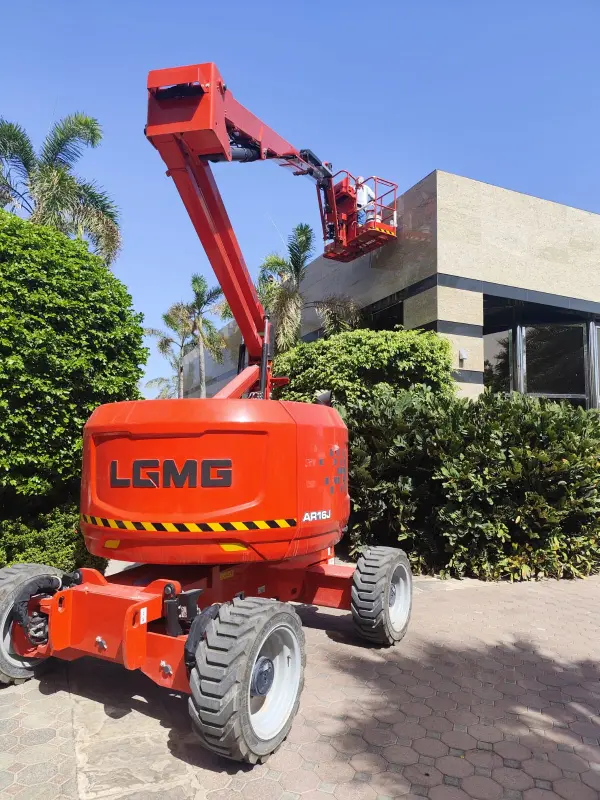
Look up from Sheikh Zayed Road and you’ll see the real picture: glass towers being clad, signage being swapped, lights being serviced, all at heights where a ladder is a bad idea. The machine behind most of that work is the boom lift.
A boom lift reaches up and over obstacles, which a scissor lift can’t do. For many Dubai jobs it is the only practical way to work at height. This guide covers the seven industries that lean on boom lifts most, the rules that shape how you hire one, and mistakes to avoid.
Why Dubai Keeps Calling for Boom Lifts
Dubai Municipality issued 10,776 building permits in Q1 2026, a 12% rise on the same period of 2025. Built-up area also climbed 48% to 3.9 million square metres. Completions are rising too: 104 projects worth more than AED 111 billion were delivered in the first half of 2026, adding 24,537 units.
Every one of those buildings needs high-level work at several stages: installing, finishing, inspecting, maintaining. Buying a boom lift for each stage rarely makes sense, which is why renting is the norm here.
1. Construction and Real Estate Development
This is the obvious one. Contractors use boom lifts for structural steel inspection, curtain wall installation, external painting, sealing and snagging on towers, villas and mixed-use projects.
Articulated (knuckle) booms suit tight sites such as Business Bay or Dubai Marina, where you work around cranes, podiums and neighbouring buildings. Telescopic booms give maximum straight-line reach on open plots.
2. Facade, Glazing and Building Maintenance
Cleaning contractors, glazing teams and facility managers handle cladding repair, sealant replacement, window replacement and exterior repainting. Boom lifts let them reach specific points without erecting full scaffolding.
Scaffolding still has a place on long, continuous facades. For spot repairs and short-duration jobs, a boom lift is usually faster to mobilise and cheaper overall.
3. MEP and HVAC Contractors
Mechanical, electrical and plumbing crews work at height constantly: ducting, cable trays, chilled-water pipework, lighting, fire-fighting lines in warehouses, malls and industrial halls.
In large indoor spaces with high ceilings, electric (battery) models give you zero exhaust fumes and lower noise. Outdoors, diesel rough-terrain machines cope better with uneven ground. If you only need to go straight up, a scissor lift may do, but boom lifts win when you need to reach across or around equipment.
4. Utilities, Telecom and Street Lighting
Street lighting, overhead cabling, telecom equipment and signal infrastructure all sit well above ground. Crews need a stable, insulated-aware platform and the ability to position precisely beside the asset, not directly below it.
Truck-mounted and self-propelled booms are common here. Before any work near live lines, the site needs a proper risk assessment and the correct authority approvals, which is part of the planning, not an afterthought.
5. Industrial, Logistics and Port-Side Operations
Jebel Ali, Dubai Industrial City, Dubai South and Dubai Investment Park are full of warehouses, plants and storage facilities. Boom lifts handle steel structure inspection, roof sheet repairs, crane-rail maintenance, high-bay racking work and plant shutdown maintenance.
Shutdowns have fixed deadlines, so equipment availability matters as much as price. A rental partner that can deliver quickly keeps a planned stoppage from turning into an extended one.
6. Events, Exhibitions and Film Production
Trade shows, concerts, product launches and film shoots need lighting rigs, banners, sound arrays and cameras positioned overhead. Boom lifts provide the elevated, mobile platform for rigging and de-rigging, often on tight overnight schedules.
Indoor venues bring floor-loading limits and surface-protection requirements, so confirm the venue’s rules before the machine arrives.
7. Signage, Advertising, Landscaping and Tree Care
Billboard installation, building-top branding, LED screen servicing, palm and tree trimming along roads and in communities all demand safe elevated access. A boom’s outreach lets crews work over fences, planters and roadside kerbs without blocking everything below.
The Rules That Shape Every Dubai Boom Lift Hire
Safe system of work. Dubai Municipality’s MEWP technical guideline (DM-HSD-GU67) says the safe system of work should rest on a risk assessment covering the type of MEWP, control measures, competence and training, and emergency arrangements. In plain terms: no paperwork, no lift.
Operator training. Industry sources note that the Dubai Municipality guideline expects operators to be trained to ISO 18878, which IPAF courses follow. Don’t assume scissor lift experience transfers. IPAF’s own guidance makes the point that scissor lift training does not carry over to boom lifts.
Fall protection. IPAF has said Dubai Municipality requires the correct fall-restraint equipment for everyone in a boom lift platform. A harness and lanyard on the operator is standard practice on booms.
Ground conditions. IPAF UAE’s chairman has warned that unsuitable ground conditions are a real hazard before setting up any MEWP. Check slopes, soft backfill, drains and basements before delivery, not after.
Summer working hours. Outdoor work in direct sunlight is banned from 12:30 PM to 3:00 PM, every year from June 15 to September 15. Penalties are AED 5,000 per worker, capped at AED 50,000 per inspection. Plan your boom lift schedule around it. Rent days that start early and finish smart.
Free zones. If your site is in a free zone, the authority may differ. For example, Dubai Development Authority issued a circular reminding sites of safe work-at-height requirements, including competent training, PPE and inspected equipment. Always confirm which regulator covers your plot.
Practical Tips Before You Book
- Start with the task, not the machine. Measure the working height and the horizontal reach you need, then add a safety margin. Boom ratings are often quoted for ideal conditions.
- Match the power source to the site. Electric for indoor and noise-sensitive jobs. Diesel or hybrid for rough ground and outdoor work.
- Ask about certification. Request inspection records, load-test certificates and operator credentials before the machine leaves the yard.
- Check access routes. Gate width, ramp gradients, tight turns and transport routes catch people out more often than you’d think.
- Confirm delivery windows. Dubai traffic and site permits can eat half a day. Agree timings in writing.
- Plan for wind. Tall boom work stops in strong gusts. Build a buffer into your schedule.
- Hire for the whole job. Short extensions cost more than planned durations. Be realistic with your estimate.
Common Mistakes to Avoid
- Choosing the cheapest rental rate over the best-maintained machine
- Sending an untrained operator because “it’s just a lift”
- Skipping the pre-use inspection under time pressure
- Forgetting the midday ban when scheduling summer work
- Ignoring overhead obstructions such as power lines, tree branches and canopies
Choosing the Right Rental Partner
The best rental partner behaves like a project partner, not just a supplier. They should help you pick between articulated, telescopic and spider options, deliver on schedule, supply documented machines and answer technical questions without a script.
If you’re comparing options for your next project, you can look at the boom lift rental in Dubai options at Up Way Transport, where the team can help match the machine to your site and schedule.
Final Thought
Boom lifts aren’t glamorous, but Dubai’s skyline doesn’t get built, cleaned, lit or maintained without them. Whether you’re in construction, facilities, events or utilities, the formula is the same: the right machine, a trained operator, a proper risk assessment and a schedule that respects UAE rules. Get those four right and the height is the easy part.