How to Calculate the Right Scissor Lift Working Height
Choosing the right scissor lift working height is essential for completing work at height safely, efficiently, and without paying for equipment that is unnecessarily large. Whether you are carrying out ceiling installation, electrical work, HVAC maintenance, painting, signage installation, or building maintenance in the UAE, the correct working height should be based on the actual height of the work area, not simply the platform height listed in the machine specifications.
For contractors and facility management teams in Dubai and across the UAE, understanding the difference between platform height and working height can make equipment selection much easier.
What Is Scissor Lift Working Height?
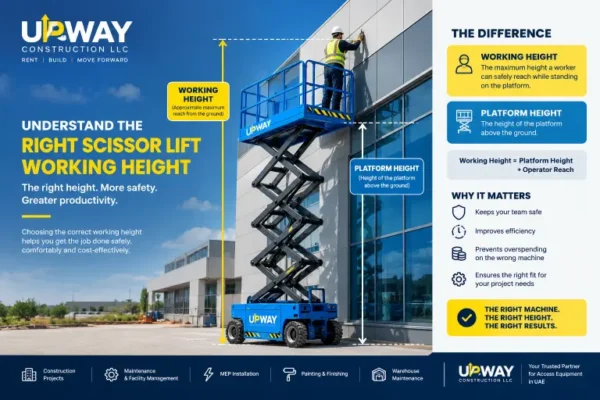
The working height of a scissor lift refers to the approximate maximum height a worker can safely reach while standing on the raised platform.
It is generally higher than the machine’s platform height because it accounts for the operator’s standing reach.
A simple way to understand it is:
Working Height = Platform Height + Operator Reach
For example, if a scissor lift has a platform height of 8 metres and the operator can safely reach approximately 2 metres above the platform:
8 m + 2 m = approximately 10 m working height
However, this is only a general calculation. The manufacturer’s published working height should always be used when selecting the machine because the actual specification can vary between models.
Platform Height vs. Working Height
One of the most common mistakes when renting a scissor lift is confusing platform height with working height.
| Specification | What It Means |
| Platform Height | Maximum height of the platform above the ground |
| Working Height | Approximate maximum height a worker can reach from the platform |
| Overall Height | Height of the machine itself, usually when lowered |
| Overall Width | Maximum machine width, important for access and indoor use |
| Lift Capacity | Maximum permitted combined load of workers, tools and materials |
For example, a machine advertised with a 10 m working height may have a platform height of roughly 8 m.
This distinction matters when determining whether a particular machine can actually reach the work area.
How to Calculate the Scissor Lift Height You Need
Calculating the required working height is relatively straightforward.
Step 1: Measure the Actual Work Height
First, determine the height of the highest point where work needs to be performed.
For example:
- Ceiling installation: 7 m
- Warehouse lighting: 9 m
- Building maintenance: 11 m
- High-level painting: 13 m
- MEP installation: 8 m
Do not estimate this measurement if accurate information is available. Architectural drawings, site measurements, or laser distance meters can help determine the actual height.
Step 2: Determine the Required Reach
The worker needs to stand comfortably on the platform while reaching the work area.
A scissor lift’s working height already accounts for operator reach in the manufacturer’s specifications, so you generally should not simply add an arbitrary amount to the platform height.
Instead, compare the required work height with the manufacturer’s stated working height.
Step 3: Add a Practical Margin
If the required height is very close to the machine’s maximum working height, choosing a machine with slightly greater capacity can provide more practical operating room.
For example, if the work area is approximately 9.5 m high, selecting a scissor lift rated at exactly 9.5 m working height may leave little room for variations in the actual work position.
A machine with a somewhat higher working-height rating may be more appropriate, provided it is suitable for the site and task.
Step 4: Check the Platform Capacity
Height is only one part of equipment selection.
You also need to consider:
- Number of workers
- Tools
- Materials
- Equipment carried onto the platform
- Maximum platform capacity
For example, a lift may provide enough height but have insufficient capacity for two workers plus tools and materials.
Always remain within the manufacturer’s rated capacity.
Scissor Lift Working Height Example
Suppose a contractor in Dubai needs to install lighting fixtures at a height of 10 metres.
The contractor should not simply look for a machine with a 10 m platform height.
Instead, the requirement should be assessed based on working height.
If a particular scissor lift provides:
- Platform height: 8 m
- Working height: approximately 10 m
it may be suitable for work around a 10 m height, assuming the machine’s other specifications meet the site requirements.
If the work is at 12 m, however, an approximately 10 m working-height machine would not be appropriate.
A higher-capacity model would need to be considered.
How Much Extra Height Do You Need?
There is no universal rule that you should always add a specific number of metres to your required height.
The correct approach is to look at the manufacturer’s working-height specification and compare it with the actual work location.
For example:
| Work Height | Potential Working-Height Requirement |
| 5 m | Around 5–6 m |
| 7 m | Around 7–8 m |
| 9 m | Around 9–10 m |
| 10 m | Around 10–11 m |
| 12 m | Around 12–13 m |
| 14 m | Around 14–15 m |
These are planning examples, not equipment-selection specifications. The actual machine should be selected using its manufacturer’s published specifications and the conditions of the job.
Why Choosing the Correct Height Matters
Selecting the wrong working height can affect both productivity and safety.
1. A Lift That Is Too Short
If the platform cannot provide sufficient working height, workers may be tempted to:
- Overreach
- Lean outside the guardrails
- Stand on rails
- Use ladders or other objects on the platform
These practices can create serious safety risks.
The solution is to select equipment that provides an appropriate working height for the task rather than trying to extend the operator’s reach beyond the intended operating position.
2. A Lift That Is Much Higher Than Necessary
A larger machine is not automatically better.
An oversized scissor lift may:
- Cost more to rent
- Be wider or heavier
- Have difficulty entering certain areas
- Require more transportation resources
- Be unsuitable for some floors or surfaces
- Reduce manoeuvrability in restricted spaces
The objective is to select the right machine for the job, not simply the tallest machine available.
Working Height Is Not the Only Specification to Check
Once you have calculated the required working height, several other specifications should be considered before renting a scissor lift.
Platform Capacity
Make sure the rated capacity can accommodate workers, tools and materials.
Platform Dimensions
A larger platform can be useful for installation and maintenance work, but it may require more space.
Machine Width
This is particularly important for indoor projects, warehouses, commercial buildings and areas with restricted access.
Machine Weight
Check whether the floor or working surface can safely support the equipment.
Terrain
Different scissor lifts are designed for different environments. Indoor slab floors and uneven outdoor construction surfaces can require different equipment characteristics.
Power Type
Depending on the project, you may need an electric or diesel-powered scissor lift.
Electric models are often suitable for indoor environments where low emissions and reduced noise are important.
Diesel rough-terrain models can be more appropriate for certain outdoor construction applications where terrain and site conditions demand greater mobility.
Choosing a Scissor Lift for UAE Projects
Construction and maintenance environments in the UAE can vary significantly.
A project in a climate-controlled commercial building may have very different equipment requirements from an outdoor construction site in Dubai.
Before renting a scissor lift, consider:
- Required working height
- Platform height
- Indoor or outdoor application
- Ground conditions
- Access width
- Door and gate dimensions
- Floor load restrictions
- Number of workers
- Tools and materials
- Required rental duration
- Site operating conditions
For outdoor projects, environmental conditions and ground stability are particularly important. For indoor projects, machine width, floor protection, emissions and manoeuvrability can become more significant.
Working Height Examples by Application
Different applications require different height ranges.
Ceiling Installation
Commercial buildings, warehouses and retail spaces may require elevated access for ceiling panels, lighting, ductwork and other overhead installations.
The appropriate lift should be selected according to the highest point requiring access.
Electrical Maintenance
Electricians may use scissor lifts for installing or maintaining high-level lighting, cable systems and electrical components.
The working height should provide comfortable access without requiring workers to overreach.
HVAC and MEP Work
MEP contractors often work at different elevations throughout a building.
In these situations, equipment selection should consider both the maximum required height and the ability to move the machine efficiently between work areas.
Painting and Finishing
Painters and maintenance contractors may need continuous access along walls, ceilings or building interiors.
Platform size and working height can both affect productivity.
Warehouse Maintenance
High-level warehouse lighting, sprinkler systems and structural maintenance can require elevated access.
In addition to working height, aisle width and floor conditions need to be checked before equipment is selected.
Common Mistakes When Calculating Scissor Lift Height
Mistake 1: Looking Only at Platform Height
A platform height of 8 m does not mean the worker can only work at 8 m.
Working height is the more relevant measurement for determining whether the equipment can reach the task.
Mistake 2: Assuming All 10 m Scissor Lifts Are the Same
Two machines with similar advertised working heights can have different:
- Platform dimensions
- Capacities
- Widths
- Weights
- Drive characteristics
- Ground-clearance specifications
Always review the complete machine specification.
Mistake 3: Ignoring the Worker’s Position
The objective is not merely to reach the work area. Workers should be able to perform the task from the platform without unsafe stretching or positioning.
Mistake 4: Choosing the Tallest Machine Available
Higher working height does not automatically make a machine more suitable.
The machine must also fit the site, access route, ground conditions and workload.
Mistake 5: Forgetting Tools and Materials
The weight of workers is not the only consideration. Tools, fixtures, equipment and materials carried onto the platform must also remain within the manufacturer’s rated capacity.
A Simple Scissor Lift Selection Formula
For initial planning, you can use this simple approach:
Required Working Height ≈ Highest Work Point
Then select a scissor lift whose manufacturer-rated working height is appropriate for that work point, while also checking the machine’s:
Capacity + Platform Size + Width + Weight + Terrain Suitability + Site Access
For example:
Highest work point: 11 m
Required machine: Scissor lift with a suitable working height above or around 11 m, depending on the exact task and manufacturer’s specifications.
The final equipment choice should be based on the manufacturer’s technical data and the actual conditions of the site.
Why Professional Equipment Selection Matters
Scissor lifts are designed to provide stable elevated access, but choosing the correct machine requires more than matching one number.
A professional equipment supplier can help evaluate the job based on:
- Required height
- Application
- Indoor/outdoor environment
- Ground conditions
- Access restrictions
- Platform capacity
- Machine dimensions
- Rental duration
This can help contractors avoid renting equipment that is unsuitable for the job or unnecessarily large.
Rent the Right Scissor Lift in Dubai
At Upway Transport LLC, we provide access equipment solutions for construction, maintenance and other work-at-height requirements in Dubai and across the UAE.
When selecting a scissor lift, our team can help you consider the required working height, platform capacity, machine dimensions, application and site conditions rather than selecting equipment based on height alone.
Whether you need a scissor lift for construction, MEP installation, warehouse maintenance, painting, electrical work or building maintenance, choosing the right machine can help your team work more efficiently while maintaining appropriate operating practices.
Need help choosing the right scissor lift working height for your project? Contact Upway Construction LLC to discuss your site requirements and equipment needs.
Quick Checklist Before Renting a Scissor Lift
Before confirming a rental, make sure you know:
- Highest point where work will be performed
- Required working height
- Required platform height
- Number of workers
- Weight of tools and materials
- Required platform capacity
- Indoor or outdoor application
- Ground conditions
- Maximum available access width
- Floor/load limitations
- Required rental period
- Appropriate machine type
Final Takeaway
Calculating the right scissor lift working height starts with one simple question:
How high does the work actually need to be performed?
Measure the highest work point, compare it with the manufacturer’s rated working height, and then evaluate capacity, platform dimensions, machine width, weight, terrain and site access.
For UAE construction and maintenance projects, selecting equipment based on the complete job requirement—not working height alone—can help you choose a safer and more practical access solution.
Upway Transport LLC can help you identify the appropriate scissor lift for your project’s height and site requirements in Dubai and the UAE.