Forklift vs Telehandler vs Boom Loader: Choosing the Right Lifting Machine for Warehouses and Yards
Moving heavy materials around a warehouse, construction site or industrial yard requires more than simply choosing a machine with enough lifting capacity. The equipment must also suit the working environment, available space, ground conditions and the position where materials need to be placed.
A forklift may be the most practical option for moving pallets between warehouse racks. A telehandler can be more suitable when materials need to be lifted over obstacles or placed at an elevated position. Meanwhile, a boom loader can offer greater flexibility for certain outdoor material-handling and construction applications.
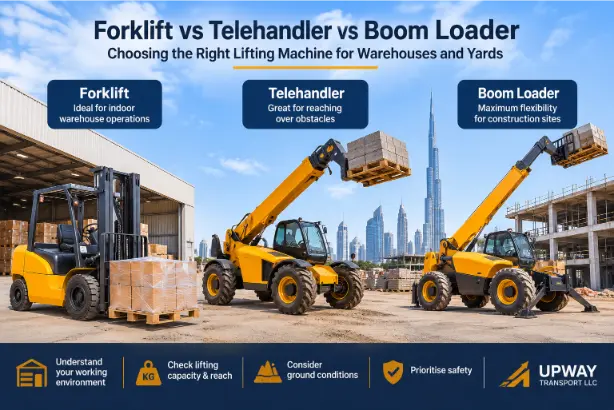
Although these machines can perform some similar tasks, they are not designed for exactly the same working conditions.
For businesses operating in Dubai and across the UAE, understanding these differences is particularly useful when managing warehouse deliveries, construction materials, industrial storage yards and outdoor logistics operations.
This guide compares forklifts, telehandlers and boom loaders, explains where each machine performs best, and highlights the factors to consider before choosing lifting equipment for your next project.
1. Understanding the Three Types of Lifting Equipment
Before comparing their performance, it helps to understand how each machine operates and what it is designed to do.
What is a forklift?
A forklift is an industrial lifting vehicle primarily designed to move, lift and stack palletised materials. It normally uses a vertical mast and a pair of forks attached to a lifting carriage.
The operator raises or lowers the forks to move materials between storage areas, loading docks, warehouse racks and delivery vehicles.
Forklifts are widely used in distribution centres, manufacturing facilities, retail warehouses and logistics yards because they can handle repetitive lifting tasks efficiently.
Common forklift applications include:
- Loading and unloading delivery trucks.
- Moving palletised products around warehouses.
- Stacking goods on storage racks.
- Handling construction materials on prepared surfaces.
- Moving industrial supplies between production areas.
- Organising stock in distribution and logistics facilities.
Electric forklifts are particularly useful in indoor environments where exhaust emissions and noise need to be controlled. Diesel and LPG models are also available for applications where their operating characteristics are appropriate.
The main advantage of a conventional forklift is its ability to move loads vertically with precision, particularly when working on level, prepared surfaces.
What is a telehandler?
A telehandler, also known as a telescopic handler, is a lifting machine fitted with an extendable boom. Unlike a conventional forklift, which lifts loads using a vertical mast, a telehandler can extend its boom forwards and upwards.
This gives it the ability to place materials at locations that may be difficult to reach with a standard forklift.
Telehandlers are commonly used on construction sites, industrial yards, agricultural properties and outdoor material-handling projects.
Typical telehandler applications include:
- Lifting building materials to upper floors.
- Placing construction supplies over walls or other obstacles.
- Loading and unloading materials from trailers.
- Handling heavy pallets on uneven ground.
- Moving supplies across large outdoor work areas.
- Positioning materials at elevated working locations.
Depending on the machine configuration, telehandlers can use different attachments, including pallet forks, buckets and approved lifting accessories.
Their telescopic boom provides greater placement flexibility, but the machine must always be operated within the rated capacity for the actual boom extension, load position and attachment.
What is a boom loader?
The term boom loader can describe different types of equipment depending on the manufacturer and industry. In this comparison, it refers to the telescopic boom-type lifting equipment offered under Upway Transport’s boom loader rental category.
This equipment uses an extending boom to lift and position materials at height and distance from the machine.
It is particularly relevant to outdoor construction, industrial material handling and projects where standard forklift reach may not be sufficient.
Typical applications include:
- Lifting construction materials to elevated work areas.
- Moving heavy loads around outdoor yards.
- Loading materials onto elevated platforms or structures.
- Positioning supplies where direct forklift access is restricted.
- Supporting material movement on suitable construction surfaces.
The exact capabilities depend on the machine model, boom configuration and attachment.
For example, Upway Transport lists a boom loader configuration with a maximum lifting height of 17 metres, a stated lifting capacity of 4,000 kg and maximum reach of 12.5 metres. These are published equipment figures, not a guarantee that the maximum load can be lifted at maximum height or reach. Always confirm the applicable load chart and machine configuration before planning a lift.
2. Forklift vs Telehandler vs Boom Loader: Key Differences
Although all three machines support material handling, their lifting mechanisms, operating environments and practical capabilities differ.
| Comparison factor | Forklift | Telehandler | Boom loader |
| Lifting mechanism | Vertical mast | Extendable telescopic boom | Extendable boom |
| Main purpose | Pallet handling and stacking | Lifting and placing materials at height and distance | Outdoor material lifting and placement |
| Working environment | Warehouses and prepared yards | Construction sites and outdoor areas | Construction and industrial yards |
| Forward reach | Limited | Extended forward reach | Extended boom reach |
| Ground conditions | Generally level, firm surfaces for standard models | Suitable models handle rougher terrain | Depends on machine type and configuration |
| Warehouse suitability | Excellent for suitable indoor models | Depends on available space and model | Depends on dimensions, power source and indoor conditions |
| Material handling | Excellent for pallets | Pallets and other compatible loads | Depends on fitted attachment |
| Manoeuvrability | Good in suitable warehouse layouts | Requires more operating space | Depends on size and steering configuration |
| Attachments | Forks, clamps and side-shifters | Forks, buckets and approved attachments | Depends on attachment compatibility |
The important distinction is not simply how much weight a machine can lift. It is how effectively it can move that load from its collection point to the required destination.
A warehouse operator may prioritise manoeuvrability and repetitive pallet movement, while a construction supervisor may need greater forward reach and the ability to work across an outdoor site.
3. Which Machine Is Best for Warehouse Operations?
Warehouses have different operational requirements from construction sites.
Indoor material handling usually involves repetitive movements, narrow aisles, storage racks, loading bays and organised pedestrian routes. Equipment must operate efficiently without creating unnecessary congestion.
Why forklifts are often the preferred warehouse option
For most conventional warehouse operations, a forklift is the practical starting point.
Its compact design, vertical lifting mechanism and manoeuvrability make it suitable for moving goods between storage locations.
Consider a distribution warehouse receiving several deliveries throughout the day. Pallets arrive at the loading dock, move through the storage area and eventually need to be placed on designated racks.
A suitable forklift can perform these tasks without requiring the additional forward reach of a telehandler.
Other advantages include:
- Efficient pallet movement: Designed for repeated loading, unloading and stacking.
- Warehouse manoeuvrability: Suitable models can navigate relatively narrow working areas.
- Indoor operating options: Electric forklifts can be suitable for enclosed facilities with appropriate ventilation and operating conditions.
- Precise positioning: The mast and carriage support controlled pallet placement.
- Attachment flexibility: Certain models can use approved clamps, side-shifters and other material-handling attachments.
However, the warehouse layout must match the forklift’s dimensions and turning requirements.
Before selecting a machine, check aisle width, rack height, door clearance, floor condition, load dimensions and the required turning radius.
When might a telehandler be useful inside a warehouse?
A telehandler is not automatically a replacement for a warehouse forklift.
Its larger dimensions and telescopic boom may make it less practical in narrow aisles or confined storage areas.
However, some industrial facilities have large open working areas, high-level material placement requirements or loading operations that extend beyond conventional warehouse handling.
In those circumstances, a suitably sized telehandler may offer additional flexibility.
The key is to assess the actual working space and required load position rather than assuming that greater reach always means better performance.
What about boom loaders?
Boom loaders are generally more relevant to outdoor and construction-related material handling than conventional indoor pallet operations.
Their suitability for indoor use depends on the specific machine, power source, emissions, dimensions, ventilation and floor capacity.
For a typical enclosed warehouse with narrow storage aisles, a forklift will usually be the more practical option.
4. When Should You Choose a Telehandler for Outdoor Yards?
Outdoor yards often involve more complicated working conditions than warehouses.
Materials may arrive on large trucks, be stored across open areas and need to be transported over gravel, compacted soil or other uneven surfaces.
In these situations, a standard warehouse forklift may not provide the required ground clearance, traction or forward reach.
A telehandler can be a more suitable choice when the machine is correctly specified for the ground and lifting conditions.
Handling materials on uneven ground
Many telehandlers are designed with large tyres, suitable ground clearance and four-wheel-drive configurations for outdoor operations.
These characteristics help them work in conditions where a conventional warehouse forklift may struggle.
However, not every telehandler is suitable for every surface. Ground bearing capacity, slopes, soft ground and site obstructions must still be assessed.
Placing materials beyond the machine’s immediate position
One of the main advantages of a telehandler is its telescopic boom.
For example, imagine a construction yard where bundles of materials need to be placed beyond a temporary barrier or at an elevated position.
A standard forklift may need to drive much closer to the unloading point, if it can reach it at all.
A telehandler may be able to position the load from a suitable stand-off distance.
This can help reduce unnecessary repositioning, provided the machine’s load chart, ground conditions and operating limits permit the lift.
Handling different types of materials
With compatible attachments, telehandlers can support different material-handling tasks.
Depending on the approved configuration, these may include:
- Moving palletised construction supplies.
- Handling timber and other building materials.
- Lifting selected industrial components.
- Moving materials around large yards.
- Supporting elevated material placement.
The attachment must be compatible with the machine, and the applicable rated capacity must be checked for that configuration.
5. How Does a Boom Loader Help with Construction and Industrial Lifting?
Construction and industrial projects often require materials to be positioned somewhere that is not directly accessible from ground level.
For example, a contractor may need to move building supplies towards an elevated structure, unload heavy materials from a delivery vehicle or position equipment at a particular working height.
A conventional forklift may be suitable for unloading the delivery vehicle but may not have the necessary forward reach to complete the next stage.
This is where telescopic boom lifting equipment becomes useful.
Greater lifting flexibility
The extending boom allows the operator to raise and position materials at different heights and horizontal distances.
This is particularly useful where the machine cannot approach the final placement point directly.
Support for outdoor construction activities
Construction yards frequently handle materials such as palletised blocks, equipment, packaged supplies and other bulky items.
A suitable boom loader can support material movement between unloading areas and designated placement locations.
Reducing unnecessary material movement
When equipment can place a load closer to its intended destination, the need for additional handling may be reduced.
For example, a contractor may be able to unload materials and position them near the required work area without moving them repeatedly using separate machines.
The actual benefit depends on site layout, load characteristics, machine reach and the lifting plan.
Equipment selection still matters
A boom loader should not be selected solely because its published maximum lifting height or capacity looks sufficient.
The required load must be assessed at its actual working position.
Upway Transport lists the following specifications for its boom loader offering:
| Specification | Published figure |
| Maximum lifting height | 17 metres |
| Maximum stated lifting capacity | 4,000 kg |
| Maximum reach | 12.5 metres |
| Engine power | 74 kW |
| Operating weight | 12,060 kg |
| Travel speed | 29 km/h |
These figures provide an initial reference for equipment planning. Confirm the exact machine, load chart, attachment and operating configuration before arranging a lift.
6. Understanding Lifting Capacity, Height and Forward Reach
One of the most common mistakes when comparing lifting machines is looking only at their maximum rated capacity.
A machine advertised with a 4-tonne lifting capacity does not necessarily lift 4 tonnes at every boom position or lifting height.
The actual safe working capacity depends on the equipment design and operating configuration.
Forklift lifting capacity
Forklift capacity is generally specified for a defined load centre, mast configuration and attachment arrangement.
The load centre describes the horizontal distance from the fork face to the load’s centre of gravity.
If a load is longer, heavier or positioned differently from the rated configuration, the available capacity may be reduced.
The operator should check the machine’s data plate and the approved attachment information before lifting.
Telehandler lifting capacity
Telehandler capacity is affected by boom extension and the position of the load.
As the boom extends forward, the load’s distance from the machine increases. This changes the forces acting on the machine and can reduce its permitted lifting capacity.
A load chart is therefore essential.
It identifies the permitted capacity for different boom positions and operating configurations.
Boom loader lifting capacity
The same principle applies to boom loaders using telescopic lifting systems.
A maximum lifting figure should never be treated as the available capacity at maximum reach.
Before selecting a machine, establish:
- The weight of the material being lifted.
- The height where the material needs to be placed.
- The horizontal distance between the machine and the placement point.
- The required attachment and its effect on rated capacity.
- The ground conditions and machine positioning requirements.
- The manufacturer’s permitted operating configuration.
A useful equipment comparison starts with the actual lifting requirement, not the largest number shown in a product description.
7. Choosing the Right Machine for Different Yard and Warehouse Situations
The following examples illustrate how equipment selection can change depending on the working environment.
Scenario 1: Moving pallets inside a distribution warehouse
Recommended option: Forklift
A distribution centre receives regular shipments of packaged products and needs to move pallets between loading bays and storage racks.
The working surface is level concrete, and the warehouse has defined aisles.
A suitable electric or other appropriately specified forklift is generally the most practical option.
Its compact design and vertical lifting mechanism support repetitive pallet movement.
A telehandler would normally offer unnecessary reach for this type of work.
Scenario 2: Unloading construction materials in an outdoor yard
Recommended option: Telehandler or suitable boom loader
A contractor receives palletised construction supplies at an outdoor storage yard.
The unloading area includes compacted ground, temporary storage zones and several obstacles.
A suitable telescopic boom machine may offer better flexibility than a conventional warehouse forklift.
The final choice depends on the load weight, ground conditions, required reach and machine configuration.
Scenario 3: Placing materials at an elevated construction level
Recommended option: Telehandler or boom loader
A project requires materials to be positioned at an elevated location where direct forklift access is restricted.
The equipment needs to reach forwards as well as upwards.
A telescopic boom machine may be suitable, provided its load chart confirms that the required load can be placed at the specified height and distance.
The working area, ground stability and exclusion zones must also be assessed.
Scenario 4: Repeated pallet handling in an industrial facility
Recommended option: Forklift
An industrial facility regularly moves packaged goods, machinery components and palletised supplies between production and storage areas.
If the work takes place on prepared surfaces and does not require extended forward reach, a forklift is likely to be the more efficient choice.
Scenario 5: Material movement across a large construction site
Recommended option: Telehandler or suitable boom loader
A construction site may have multiple material storage areas, uneven surfaces and elevated placement requirements.
A telescopic boom machine can offer flexibility for handling compatible loads across the site.
The operator must still follow the machine’s travel, lifting and stability requirements.
The best option depends on the complete job rather than the site category alone.
8. Important Factors to Check Before Hiring Lifting Equipment
Choosing the right equipment requires more than comparing rental prices or advertised specifications.
A few practical checks can help prevent delays, unsuitable deliveries and unnecessary equipment changes.
1. Understand the material being lifted
Start with the load itself.
Is it palletised, loose, bulky, unusually long or irregularly shaped?
The material’s dimensions and centre of gravity can influence which machine and attachment are appropriate.
2. Measure the required lifting height
Identify where the material needs to be placed.
For warehouse operations, this may be a storage rack or loading platform. For construction work, it may be an elevated floor, structure or designated material storage area.
Measure the actual placement height rather than relying on an approximate estimate.
3. Calculate the horizontal reach
If the machine needs to place materials beyond its immediate position, forward reach becomes an important selection factor.
A forklift generally keeps its load close to the machine, whereas a telehandler or boom loader can extend its boom forwards.
4. Check ground and floor conditions
Indoor warehouses typically require suitable floor conditions and adequate floor-loading capacity.
Outdoor yards may involve gravel, compacted soil, slopes, loose surfaces or temporary access routes.
The equipment must be suitable for the surface and the expected loading conditions.
5. Consider available operating space
Measure the entrance, working aisle, turning area and overhead clearance.
A machine may have sufficient lifting capacity but still be unsuitable if it cannot manoeuvre safely around the site.
6. Confirm attachment requirements
Different materials may require different attachments.
Check whether the equipment supports the required forks, bucket or other approved attachment.
Do not assume that an attachment can be transferred between different machine types without checking compatibility and rated capacity.
7. Plan delivery and unloading
Equipment delivery should be considered before confirming a rental.
Check site access, unloading space, transport dimensions and any restrictions affecting the delivery vehicle.
For projects in Dubai’s industrial and construction areas, these details can make a difference to the equipment mobilisation process.
8. Confirm operator and safety arrangements
The machine should be operated by personnel with the appropriate training, competence and authorisation for the equipment and site conditions.
Confirm operator arrangements with the rental provider and establish suitable pedestrian separation, traffic routes and lifting controls before work begins.
9. Common Mistakes When Selecting a Forklift or Telehandler
Even experienced site teams can encounter problems when equipment is selected without properly assessing the working requirements.
Here are some common mistakes worth avoiding.
| Common mistake | Why it creates problems | Better approach |
| Choosing only by maximum lifting capacity | Capacity changes with configuration and load position | Check the data plate or load chart |
| Using a standard forklift on unsuitable ground | Poor traction or unstable working conditions may affect safe operation | Select equipment designed for the actual surface |
| Hiring a telehandler for narrow warehouse aisles | Machine dimensions may restrict movement | Measure the aisle and turning clearance |
| Ignoring forward reach | The machine may not reach the intended placement point | Calculate the required horizontal distance |
| Overlooking attachment weight | Attachments can affect available lifting capacity | Check the approved attachment configuration |
| Assuming maximum height equals maximum capacity | Maximum capacity may not be available at maximum reach | Check the load chart for the actual lift |
| Forgetting delivery access | The equipment may be unsuitable for the unloading location | Confirm transport and site access beforehand |
The most effective approach is to understand the job first and select the machine afterwards.
10. Seasonal Equipment Planning for Warehouses and Outdoor Yards in the UAE
Equipment requirements can change throughout the year, particularly for businesses managing seasonal inventory, construction schedules and outdoor material-handling operations.
In Dubai and other parts of the UAE, seasonal planning is relevant because warehouse activity, outdoor working conditions and project schedules may vary.
Planning warehouse operations during busy trading periods
Retail distribution centres, importers and logistics companies may experience increased stock movement during major sales periods, promotional campaigns and seasonal inventory changes.
During busier periods, additional material-handling capacity may be needed for:
- Receiving larger volumes of incoming stock.
- Moving additional pallets between storage areas.
- Organising temporary storage locations.
- Supporting loading and unloading schedules.
- Maintaining efficient movement between warehouse zones.
A forklift may be the most suitable option for repetitive indoor handling, while a different machine may be needed for outdoor unloading or elevated material placement.
Preparing outdoor yards for changing conditions
Outdoor construction and industrial yards also need to consider seasonal operating conditions.
Heat, dust, surface conditions and changing site activity can affect equipment planning.
During hotter periods, project managers should consider suitable operating schedules, equipment condition, operator welfare and the manufacturer’s requirements for working conditions.
For material handling on outdoor construction sites, telehandlers and suitable boom loaders may offer advantages where additional reach and terrain capability are required.
Why advance rental planning matters
Waiting until equipment is urgently needed can limit the available choices.
Planning ahead allows site teams to communicate their lifting requirements, confirm machine suitability and coordinate delivery around project schedules.
For businesses that need additional lifting capacity temporarily, equipment rental can provide flexibility without committing to purchasing machinery that may only be required for a particular project or busy period.
11. Forklift vs Telehandler vs Boom Loader: Which One Should You Choose?
There is no single machine that is best for every warehouse, yard or construction project.
The right choice depends on the work, operating environment and required placement position.
Use this simple decision guide:
Choose a forklift when:
- You mainly handle palletised materials.
- Your work takes place on level, prepared surfaces.
- You need to move goods repeatedly between storage areas.
- You operate inside a warehouse or distribution facility.
- You need efficient stacking and loading operations.
Choose a telehandler when:
- You need forward and vertical lifting reach.
- Your work takes place on suitable uneven outdoor surfaces.
- You need to position materials over obstacles.
- You handle materials on construction or industrial sites.
- You require compatible attachments for different lifting tasks.
Choose a boom loader when:
- Your project requires telescopic boom-based material placement.
- Materials need to be lifted to an elevated working location.
- You need additional forward reach for outdoor lifting.
- Your construction or industrial operation requires flexible material handling.
- The machine’s verified load chart and configuration suit the planned lift.
The important point is to match the machine to the actual lifting conditions rather than selecting equipment based on its name alone.
12. Frequently Asked Questions
Is a telehandler better than a forklift?
Neither machine is universally better. A forklift is generally more suitable for repetitive pallet handling on prepared surfaces, particularly in warehouses. A telehandler is more appropriate when materials need to be placed at height or beyond the machine’s immediate position, especially in suitable outdoor conditions.
What is the main difference between a forklift and a boom loader?
A conventional forklift uses a vertical mast to raise and lower materials. A boom loader in the telescopic lifting category uses an extending boom to move loads upwards and forwards. This provides additional placement flexibility for certain construction and outdoor material-handling applications.
Can a telehandler replace a forklift?
A telehandler can perform some tasks that would otherwise require a forklift, particularly outdoor material movement and elevated placement. However, it is not necessarily a practical replacement for warehouse forklifts, especially where narrow aisles and repetitive pallet handling are involved.
Which lifting machine is best for uneven ground?
A suitably specified telehandler or rough-terrain lifting machine is generally a better choice for uneven outdoor surfaces than a conventional warehouse forklift. However, actual suitability depends on the machine’s configuration, ground conditions, slope limits and manufacturer instructions.
Can a boom loader lift materials to a second floor?
Certain boom loaders and telescopic handlers can place materials at elevated levels. However, the required lifting height, horizontal reach, load weight and machine configuration must all be checked against the applicable load chart before the operation is planned.
What should I check before renting a telehandler in Dubai?
Consider the load weight, lifting height, forward reach, ground conditions, attachment requirements, access dimensions, rental duration and operator arrangements. Also confirm the exact machine specifications and delivery requirements with the equipment provider.
Is a forklift suitable for outdoor construction sites?
Some forklifts are designed for outdoor use, including rough-terrain models. However, a conventional warehouse forklift may not be suitable for loose, uneven or soft ground. Select the machine according to the actual surface and operating conditions.
Why rent lifting equipment instead of purchasing it?
Rental can be practical when additional lifting capacity is needed for a temporary project, seasonal workload or specific construction activity. It also allows businesses to select equipment according to individual job requirements rather than maintaining a larger permanent fleet.
Final Thoughts
Choosing between a forklift, telehandler and boom loader comes down to understanding what needs to be lifted, where the material needs to go and what conditions the machine will encounter.
For warehouse operations involving regular pallet movement, a forklift is often the most practical choice. For outdoor work requiring greater forward reach and elevated material placement, a telehandler or suitable boom loader may provide more flexibility.
Before arranging equipment, assess the load weight, working height, horizontal reach, ground conditions and available operating space. These details help identify a machine that is suitable for the task rather than simply choosing the largest available option.
At Upway Transport LLC, we understand that different projects require different material-handling solutions. Our boom loader rental service in Dubai supports contractors and businesses looking for suitable lifting equipment for construction and industrial applications.
If you are unsure which equipment is appropriate for your site, share your load requirements, working height, location and expected rental period with our team. We can help you discuss the available equipment options and identify a suitable solution for your project.
Explore Upway Transport’s equipment and rental services for more information.