Spider Lift Rental for Narrow Access Areas: How to Plan the Right Equipment
A narrow entrance, a finished floor or a crowded working area can turn a straightforward maintenance job into a difficult access problem. A conventional boom lift may offer sufficient height but fail to pass through a doorway. Scaffolding may take up valuable space, while a larger machine could be unsuitable for the available floor area or ground conditions.
In these situations, a spider lift can be worth considering. Its compact tracked chassis and deployable stabilisers allow certain models to access restricted locations and establish a working position where larger access equipment may not fit.
However, a spider lift is suitable for a narrow-access job only when its transport dimensions, working configuration, reach, stabilizer footprint, and ground requirements match the site. A machine that fits through an entrance may still be too large to set up or operate safely once inside.
This guide explains how to assess narrow access areas before arranging spider lift rental in Dubai or elsewhere in the UAE, helping project managers, maintenance teams, and contractors identify the practical requirements before equipment arrives.
What Makes a Spider Lift Useful in Narrow Access Areas?
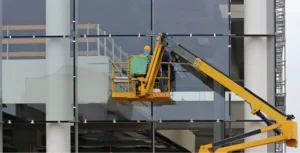
A spider lift is an elevated work platform that typically combines a compact chassis, tracked mobility, a boom and multiple stabiliser legs. The stabilisers extend when the machine is set up for work, providing the support required for its intended operating configuration.
Unlike some conventional boom lifts, certain spider lift models are designed to travel through comparatively narrow access routes and operate in locations with limited space. Some models also offer power options suited to indoor applications, although the available configuration varies by machine.
These characteristics can make spider lifts useful for projects involving:
- Narrow doorways, corridors and internal access routes.
- Building atriums and areas beneath high ceilings.
- Maintenance in buildings with restricted equipment access.
- Elevated work near architectural features or fixed installations.
- Selected outdoor locations with limited positioning space.
- Projects where the ground or finished surface requires careful equipment assessment.
The important point is that compact transport dimensions do not tell the whole story. A spider lift also needs enough room for its stabilisers, boom movement, platform positioning and safe operation.
1. Measure the Access Route Before Choosing a Spider Lift
The first step is to establish whether the machine can physically reach the work area.
Contractors sometimes measure a doorway and assume that any machine narrower than the opening will fit. In practice, the route may include turns, ramps, thresholds, low ceilings or other restrictions that affect access.
Before requesting a rental, inspect the entire route from the delivery point to the intended working position.
Check these access measurements.
Clear doorway width: Measure the narrowest usable opening, including any door frames, handles, or permanent fittings that reduce the available clearance.
Clearance height: Check overhead beams, door closers, suspended signs, pipes, and other obstructions.
Turning space: A machine may fit through a straight opening but struggle to negotiate a tight turn immediately afterwards.
Corridor width: Measure pinch points along the route rather than relying on the corridor’s widest section.
Thresholds and ramps: Identify steps, floor transitions, slopes and uneven sections that may affect tracked movement.
Lift and loading access: If the machine must enter through a goods lift or loading bay, confirm the relevant dimensions, permitted loading and access arrangements.
Also establish whether doors can be fully opened and whether temporary obstructions can be removed before delivery.
A site plan with marked dimensions and photographs of difficult sections can help the rental supplier assess the access requirement. For particularly restricted routes, the exact machine’s transport configuration should be confirmed before delivery is booked.
2. Allow for the Space Needed to Set Up the Lift
Getting a spider lift through a narrow entrance is only the first part of the job. Once it reaches the work area, the machine needs a suitable position for its stabilizers and enough clearance for the boom and platform to move.
This is especially important in atriums, internal courtyards, compact plant rooms, and buildings where furniture, equipment, or structural features limit the available floor area.
Why stabiliser space matters
Spider lifts use stabilisers to support the machine during elevated operation. The deployed footprint can be significantly wider than the machine’s transport width.
The exact footprint depends on the model and the stabiliser configuration. Some machines offer different stabiliser positions, but these must only be used in configurations permitted by the manufacturer and applicable operating instructions.
Before selecting equipment, confirm:
- The available floor area at the proposed setup point.
- The required stabiliser footprint for the intended working configuration.
- The position of nearby walls, columns, machinery and other obstacles.
- Whether each stabiliser can be placed on an approved supporting surface.
- Whether the boom can reach the work area without entering a prohibited zone.
- Whether the platform can be lowered and recovered safely if the work stops.
Do not assume that stabilisers can be placed partly on a drain cover, service trench, unsupported slab edge or other questionable surface. If the supporting capacity is uncertain, obtain an appropriate assessment before operating the equipment.
3. Check Floor Loading and Ground Conditions
A spider lift’s compact design does not automatically make it suitable for every floor.
The machine’s weight, track contact pressures, stabiliser reactions and operating configuration all influence the loads transferred to the supporting surface. In some circumstances, stabiliser loads may be more important than the load from the tracks while travelling.
This is particularly relevant when working inside finished buildings, above basements, on suspended floors or near underground services.
Indoor surfaces
Before bringing a spider lift into a building, check the floor type and any loading restrictions. Polished stone, decorative tiles, resin flooring and other finished surfaces may also require protection measures agreed with the building manager.
Non-marking tracks may be available on certain models, but they do not guarantee that a floor cannot be scratched, stained or damaged. Dirt, trapped debris, turning movements and stabiliser placement can also affect the surface.
Outdoor surfaces
Outdoor access areas can present different problems, including soft ground, slopes, paving, drainage channels and concealed service covers.
A tracked chassis does not mean the machine can travel safely across every uneven surface. Confirm the manufacturer’s limits for travel, gradient and ground conditions, and assess whether the setup position can support the stabilisers.
Where floor or ground capacity is unknown, do not rely on visual appearance alone. Obtain the necessary site or structural assessment before proceeding.
4. Match Working Height and Outreach to the Actual Task
The required height is only one part of equipment selection. A spider lift must also be able to reach the work point from the proposed setup position.
For example, a technician may need to inspect an overhead installation above a fixed reception desk. The required platform height might be achievable, but the machine may need to extend horizontally to reach the installation without placing its tracks or stabilisers on the restricted area.
This is where working height, horizontal outreach and the manufacturer’s working-envelope diagram become important.
What should you measure?
Working height: The stated height at which the worker can perform the task, using the manufacturer’s definition.
Platform height: The height of the platform floor above the supporting surface.
Horizontal outreach: How far the platform can reach horizontally from the machine’s reference position.
Obstacle clearance: Whether the boom can reach the task without contacting ceilings, beams, façades, machinery or other structures.
Working position: The location where the machine can be set up with its stabilisers correctly deployed.
A lift that can reach the required height may still be unsuitable if it cannot provide sufficient outreach or if the required boom movement is obstructed.
Give the rental supplier the actual work height, estimated horizontal distance and photographs or a sketch showing the intended setup position. The final selection should be checked against the specifications and working envelope of the exact model.
5. Choose the Right Power Configuration for Indoor or Outdoor Work
Spider lifts may be available with different power configurations, depending on the model. These can include engine-powered, electric or hybrid arrangements.
The correct choice depends on where the lift will operate, the site’s restrictions and the equipment specification—not simply whether the job is indoors or outdoors.
For indoor work
Consider whether the building permits engine exhaust, what ventilation is available, and whether noise or emissions could affect occupants or other work activities.
An electric or otherwise suitable low-emission configuration may be appropriate for certain indoor tasks. Confirm the model’s power requirements, battery arrangements, charging access and operating duration before booking.
For outdoor work
Assess the terrain, surface firmness, weather exposure and the distance between the setup point and the task. The selected machine must be suitable for the actual ground and operating conditions.
Some projects may require both indoor and outdoor access. In that case, confirm that the chosen model can safely meet the requirements of each area and that the transition between areas is permitted by the manufacturer.
6. Plan the Delivery and Movement Through the Building
Narrow-access projects can be delayed even when the selected machine is technically suitable. Delivery restrictions, security procedures, busy loading areas and limited movement space can all affect the schedule.
For a smooth handover, coordinate the delivery plan with the site team before the rental period begins.
Prepare the site in advance
- Confirm the delivery location. Identify where the transporter can stop and unload without obstructing other site activities.
- Arrange access permissions. Check security procedures, delivery windows and any building-management approval.
- Clear the route. Remove movable obstructions where authorised and ensure the planned route is available.
- Protect finished surfaces. Agree on suitable protection with the responsible site team.
- Confirm the setup area. Ensure the work area is ready for the stabilisers and intended boom movement.
- Brief the operator and site team. Agree on access control, pedestrian separation and the working sequence.
Do not plan to force a machine through an opening or remove structural or building components without proper authorisation. If the available access route is too restrictive, reconsider the machine or the work method before delivery.
7. Where Are Spider Lifts Commonly Used for Restricted Access Work?
The most useful way to evaluate a spider lift is to start with the access problem rather than a list of industries.
Atriums and high-ceiling interiors
Atriums can have substantial vertical clearance but limited floor-level access due to seating, architectural features, reception areas or other fixed installations.
A spider lift may be suitable when its transport dimensions allow entry and its stabilisers can be deployed in an approved position. The required working height and outreach must be checked against the actual layout.
Commercial building maintenance
Lighting, inspection and selected repair tasks may take place above finished floors or within areas that cannot accommodate a larger machine.
The decision should account for floor protection, access width, working hours, occupant movement and the space needed to isolate the work area.
Industrial facilities and plant areas
Existing machinery, pipes, ducts and cable systems can restrict the approach to elevated maintenance points.
An articulating spider lift may offer useful positioning flexibility, depending on its working envelope. However, the machine must not be positioned or operated in a way that creates contact hazards with equipment, services or structures.
Residential and architectural maintenance
Certain villas, courtyards and buildings with landscaped areas or restricted entrances may present access challenges for conventional equipment.
Before selecting a lift, consider paving, steps, garden features, overhead clearance and the space needed to deploy stabilisers. Lightweight construction alone does not guarantee that the ground or finished surfaces can support the machine safely.
These examples describe potential applications, not a guarantee that every spider lift can perform each task.
8. When Is a Spider Lift Not the Best Choice?
A spider lift is not automatically the right solution simply because an area is narrow.
Other access methods may be more appropriate if the machine cannot enter, its stabilisers cannot be deployed safely, or its working envelope does not reach the task.
Consider another solution when:
- The entrance is too narrow or too low for the machine’s transport configuration.
- The working area cannot accommodate the required stabiliser footprint.
- Floor loading or ground stability cannot be established.
- The required height or outreach exceeds the machine’s limits.
- Overhead obstructions prevent safe boom movement.
- The task requires lifting materials beyond the platform’s permitted capacity or intended use.
- The job can be completed more appropriately with another access method after a competent assessment.
Depending on the job, alternatives may include a compact electric scissor lift for straightforward vertical access, a suitable conventional boom lift where there is sufficient positioning space, or a properly designed scaffold system.
The decision should be based on the actual work requirements, site conditions and safe method of access rather than on the equipment category alone.
9. Safety Checks Before Operating a Spider Lift
Restricted spaces introduce additional risks because the machine may operate close to walls, ceilings, structural elements, pedestrians or existing equipment.
Before work starts, the site team and operator should confirm that the machine is suitable for the task and that the operating area is controlled.
Key checks include:
- Operator competence: The operator must be trained and authorised for the equipment and understand its controls and operating limits.
- Pre-use inspection: Complete the required checks and report defects before operation.
- Stabiliser setup: Deploy stabilisers only as specified by the manufacturer, on suitable supporting surfaces.
- Overhead clearance: Identify beams, ceilings, cables, pipework and other potential contact hazards.
- Crush hazards: Assess the risk of trapping the platform or operator against structures and equipment.
- Platform loading: Keep the combined weight of occupants, tools and materials within the rated capacity.
- Fall protection: Follow the manufacturer’s instructions and applicable site requirements; keep the platform gate secured and do not climb on rails.
- Exclusion zones: Prevent unauthorised access to the operating area and manage pedestrian movement.
- Emergency procedures: Ensure the site team understands the machine’s emergency-lowering arrangements and how assistance will be provided.
- Weather and environment: Observe the manufacturer’s limits for wind, temperature, surface conditions and other operating restrictions.
A spider lift must not be operated on the assumption that its stabilisers compensate for an unsuitable surface or that its compact size removes the need for a risk assessment.
For further technical context, consult the equipment manufacturer’s operating manual and applicable UAE occupational health and safety requirements.
10. What Information Should You Provide When Renting a Spider Lift?
A useful rental enquiry describes the site constraints as clearly as the work itself. This helps the supplier assess the appropriate equipment and identify missing measurements before arranging delivery.
Prepare the following information:
| Information | What to provide |
|---|---|
| Project location | Site address and delivery restrictions |
| Work description | Inspection, installation, repair or maintenance task |
| Required height | Actual height of the work point |
| Horizontal reach | Approximate distance from the proposed setup point |
| Entrance dimensions | Narrowest clear width and height along the access route |
| Route conditions | Turns, ramps, thresholds, corridors and overhead obstructions |
| Setup area | Available space for the machine and deployed stabilisers |
| Floor or ground | Surface type and known loading restrictions |
| Working environment | Indoor, outdoor or a combination of both |
| Platform load | Number of workers and estimated weight of tools and materials |
| Rental duration | Planned dates and expected hire period |
| Site rules | Access permissions, working hours, surface protection and safety requirements |
If you are unsure about a measurement, state that clearly rather than estimating with false precision. Photographs, a marked-up floor plan and the position of the intended work point can help the rental team identify what else needs to be checked.
For Upway Transport LLC, equipment suitability, specifications, rental rates and availability should be confirmed for the actual project and requested dates.
Frequently Asked Questions
What is a spider lift used for in narrow access areas?
A spider lift is used to provide elevated access where a conventional lift may struggle to enter or position itself. Potential applications include atriums, restricted building interiors, industrial maintenance areas and certain architectural projects. Suitability depends on the exact machine and site conditions.
Can a spider lift fit through a standard doorway?
Some spider lifts have compact transport dimensions, but there is no single doorway size that suits every model. Measure the clear opening and the full access route, then compare those measurements with the selected machine’s transport dimensions.
Do spider lifts need more space when working than when travelling?
Yes. The stabilisers generally extend when the machine is set up, creating a larger operating footprint than its compact transport configuration. The required space depends on the machine and the permitted stabiliser setup.
Are spider lifts suitable for delicate floors?
Some models offer features such as low ground pressure or non-marking tracks, but no machine should be assumed safe for every finished floor. Check machine weight, track and stabiliser loads, surface condition and the floor’s permitted loading before use.
Can a spider lift work on uneven ground?
Certain spider lifts are designed for specific uneven-ground conditions, but the permitted setup depends on the model, ground stability, slope and stabiliser requirements. Never assume that tracks and stabilisers make every surface safe.
How do I choose the right working height?
Measure the actual work point and check the manufacturer’s working-height definition. Also assess horizontal outreach, obstacles and the intended setup position. Maximum working height alone does not prove that the lift can reach the task.
Is a spider lift better than a scissor lift for restricted access?
It depends on the task. A scissor lift may suit a job requiring mainly vertical access from a stable platform, provided the machine can enter and operate in the available space. A spider lift may be more appropriate where a compact transport configuration and flexible boom positioning are needed. Compare the exact machines and site requirements.
What affects spider lift rental cost in Dubai?
Cost may depend on the selected model, required reach, rental duration, delivery and collection arrangements, site access, power configuration and availability. Provide the project details to obtain a quotation based on the actual requirement.
Plan Your Narrow-Access Project Before Booking
A successful spider lift rental starts with more than the required working height. The machine must pass through the access route, fit within the setup area, support the task’s reach requirements and operate on a suitable surface.
Measure the narrowest entrance, inspect the route, confirm the stabiliser footprint and assess the floor or ground before choosing equipment. These checks help identify access problems before delivery and provide a clearer basis for selecting a suitable machine.
If your project in Dubai or elsewhere in the UAE involves restricted access, atriums, internal maintenance areas or other difficult working positions, visit Upway Transport’s spider lift rental page to discuss your requirements.
Share the work location, access dimensions, required height, horizontal reach and site conditions so the appropriate equipment and current availability can be confirmed.