Choosing between a backhoe loader, mini excavator and full-size excavator depends on more than the amount of soil you need to remove. You also need to consider how often the machine will switch between digging and loading, the depth and shape of the excavation, the ground conditions, site access and the time available to complete the work.
For a site with open access, normal soil, a required digging depth of approximately 1–3 metres and several stages of general site preparation, a backhoe loader is a sensible first machine to assess when digging, loading and moving material are all regular tasks. A mini excavator may be better for precise or localised digging, while a full-size excavator is worth comparing when excavation volume or programme pressure makes digging output the main priority.
The right choice should be based on the exact machine specifications and the work sequence, not simply the equipment category.
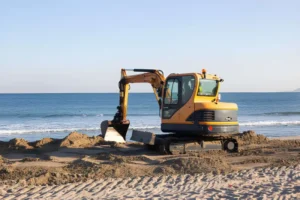
Backhoe Loader vs Excavator: The Main Differences
A backhoe loader combines a front loader bucket with a rear excavating arm. An excavator uses a boom, arm and bucket primarily for digging and moving excavated material. Mini excavators follow the same basic excavator design but use a more compact chassis and are generally suited to smaller working areas.
| Selection factor | Backhoe loader | Mini excavator | Full-size excavator |
| Main strength | Digging and loading with one machine | Controlled, localised excavation | Sustained excavation and larger earthmoving tasks |
| General site preparation | Well suited to mixed tasks | Suitable for smaller or more precise work | Suitable where excavation is the dominant task |
| Loading loose soil | Front loader bucket is useful | Usually needs another handling method for regular loading | Can load suitable trucks, depending on machine and setup |
| Trench and foundation work | Suitable when depth, reach and bucket width match the job | Useful for narrower or more controlled excavations | Suitable for larger excavation requirements |
| Open-site mobility | Wheeled design can make repositioning practical | Compact tracked design, depending on model | Often tracked, with transport arrangements depending on size |
| Space requirements | Needs room to manoeuvre and position both ends | Often the better option for restricted access | Usually needs more space and ground support |
| Best reason to choose it | One machine needs to perform several kinds of work | Precision or compact access matters most | Excavation volume and schedule drive the decision |
These are general equipment characteristics. Actual performance varies with the make, model, bucket, operator, material, working conditions and site layout.
1. When Is a Backhoe Loader the Better Choice?
A backhoe loader is often a practical option when a site requires several related tasks rather than continuous excavation alone. Its front bucket can handle loose material, while the rear arm performs digging.
For example, a site preparation job might involve excavating shallow foundations, digging service trenches, moving soil away from the work area and spreading material during initial levelling. A backhoe loader can perform different parts of this sequence without requiring a separate excavator and loader for every task.
Why it suits mixed-site preparation
- Digging and loading: The rear excavating arm and front loader bucket support different tasks on the same machine.
- Frequent repositioning: Its wheeled design can be useful when work areas are spread across an accessible site.
- Several work stages: The machine can move between excavation, material handling and some rough levelling tasks.
- Equipment coordination: Using one multipurpose machine may simplify scheduling when the workload does not justify two dedicated machines.
A backhoe loader is not automatically the fastest or cheapest option. If the machine spends most of the day digging, its loading capability may provide less benefit. If the work involves frequent loading and shifting, however, that versatility may be valuable.
What should you check before renting one?
Confirm the maximum digging depth, reach at the required working position, bucket widths and capacities, loader dump height and access dimensions. Also establish whether the machine can reach the excavation from a stable working position without repeatedly moving or repositioning.
Upway Transport’s published services page lists backhoe loaders with an approximate operating weight of 7,500–8,500 kg, a stated maximum backhoe digging depth of up to 4.7 m, a 1.0 m³ loader bucket and a 0.3 m³ backhoe bucket. These are the specifications published on the page, not a guarantee that every machine in the category has those dimensions. Confirm the supplied model and its actual configuration before booking.
2. When Is a Mini Excavator More Suitable?
A mini excavator is worth considering when the work requires careful digging in a relatively small area, particularly where the shape and position of the excavation matter more than having a front loader bucket.
Typical applications include narrow trenches, localised foundation excavation, landscaping, drainage work and utility installation. The appropriate machine size depends on the required digging depth, bucket width, reach and the space available to operate safely.
Why choose a mini excavator?
- Controlled digging: Its excavator configuration is useful for digging to a defined line or depth.
- Compact working footprint: Depending on the model, it may access areas that are unsuitable for larger equipment.
- Localised excavation: It can be appropriate where only specific sections of a site need to be opened.
- Reduced machine size: A smaller machine may be easier to position in a constrained work zone, provided the access route and ground conditions are suitable.
The main trade-off is material handling. A mini excavator can dig and move soil within its working range, but it does not have the same front loader arrangement as a backhoe loader. If regular loading and shifting are major parts of the project, you may need a separate loader, a suitable transport arrangement or a different machine choice.
A compact machine is not necessarily the best option simply because the excavation is only 1–3 m deep. Its reach, bucket capacity, ground conditions and achievable output still need to match the job.
Upway Transport has a mini excavator rental page describing compact excavation applications. Ask the company to confirm the exact model, digging range, dimensions and availability for your planned work.
3. When Should You Consider a Full-Size Excavator?
A full-size excavator becomes more attractive when excavation is the dominant activity, the volume of soil is substantial or the project schedule places a premium on sustained digging output.
Its larger bucket options and working range can be useful for bulk earthmoving, substantial foundations, larger trenches and excavation where material needs to be loaded into trucks. The machine must still be selected according to the required depth, reach, bucket configuration and loading arrangement.
Situations where it may be the stronger option
- Excavation takes up most of the planned machine hours.
- The soil removal volume is high relative to the available working days.
- Trucks can access the excavation area and be positioned safely for loading.
- The site has enough room for the machine, its working radius and transport access.
- A smaller machine’s output would make the completion schedule difficult to achieve.
A full-size excavator may be unnecessarily large for a modest, multi-stage job. Larger equipment can introduce additional transport, access, positioning and ground-bearing considerations. It may also leave the loading and levelling work dependent on another machine.
The goal is not to rent the largest excavator available; it is to select a machine whose working range and practical output suit the excavation plan.
4. Which Machine Fits a 1–3 m Deep, 100–500 m³ Site Preparation Job?
For a job with open access, normal soil, a required digging depth of approximately 1–3 m, regular material handling and a rental period of 3–7 days, a backhoe loader is the first option I would assess.
This recommendation is based on the combination of tasks, not depth alone. The planned depth falls within the published maximum digging depth for the backhoe loader category listed on Upway Transport’s services page, but the actual machine’s specification must be confirmed.
The total volume and deadline could change the recommendation.
Compare the estimated daily excavation requirement
The following figures are simple planning calculations. They are not estimates of what any machine will excavate per day.
| Total excavation volume | 3-day schedule | 5-day schedule | 7-day schedule |
| 100 m³ | 33.3 m³/day | 20 m³/day | 14.3 m³/day |
| 250 m³ | 83.3 m³/day | 50 m³/day | 35.7 m³/day |
| 500 m³ | 166.7 m³/day | 100 m³/day | 71.4 m³/day |
Actual daily output depends on bucket capacity, material type, excavation geometry, cycle time, operator experience, repositioning, loading arrangements, truck availability and working hours. Excavated soil may also occupy a different volume after it is loosened, so the volume measurement method should be clarified.
Preliminary equipment recommendation
| Project situation | First option to assess | Reason |
| Around 100 m³, spread across several tasks | Backhoe loader | Its combined digging and loading functions may suit the work sequence |
| Around 250 m³, with regular loading and shifting | Backhoe loader; compare excavator if digging dominates | The balance between excavation and material handling determines the better fit |
| Around 500 m³, especially within 3–5 days | Compare backhoe loader with a suitable full-size excavator | Sustained excavation output may become more important |
| Narrow trenches or highly localised excavation | Mini excavator | Precise positioning and compact dimensions may be more useful |
| Large excavation with frequent truck loading | Suitable excavator plus a planned loading and haulage arrangement | The full excavation-and-removal cycle determines productivity |
These are selection guidelines, not guaranteed productivity or rental-cost conclusions. A contractor or equipment supplier should review the actual dimensions and work sequence before finalising the machine.
5. What Measurements Do You Need Before Renting?
Before requesting a quotation, collect the following information. It helps the supplier identify a suitable machine instead of recommending equipment based only on a broad description of the work.
Excavation dimensions
Record the length, width and depth of each excavation area. If the ground will be excavated to different levels, provide the depth range and the approximate volume for each section.
For a simple rectangular excavation, a preliminary volume can be calculated as:
\[ \text{Volume}=\text{Length}\times\text{Width}\times\text{Depth} \]
For example, a trench 20 m long, 1 m wide and 1.5 m deep has a theoretical in-place volume of 30 m³, before allowing for sloping sides, over-excavation or other design requirements. Irregular excavations require a more appropriate measurement method.
Access and working space
Measure the entrance width and height, available turning area and clearance around the excavation. For a wheeled backhoe loader, confirm that it can manoeuvre and position safely. For an excavator, confirm that its width, tail swing and working radius suit the site.
Open access is helpful, but it does not remove the need to check ground bearing capacity, slopes, underground services and overhead hazards.
Soil and disposal arrangements
Describe the ground as accurately as possible. Normal soil may be suitable for conventional buckets, but compacted material, gravel, buried debris or rock can change the equipment and attachment requirements.
Also confirm where the excavated material will go. Loading directly into trucks, stockpiling on site and spreading soil around the site create different work cycles. If soil must be removed, allow for truck capacity, access and waiting time.
Work schedule
Specify the rental period, daily working hours, planned start date and completion deadline. A 500 m³ job over three days has a very different planning requirement from the same volume over seven days. The supplier needs enough information to assess whether one machine is appropriate or a different arrangement should be considered.
6. Rental Planning: What Affects the Overall Cost?
The cheapest daily rental rate does not necessarily mean the lowest total project cost. The equipment must complete the work within the required schedule and suit the tasks that occur throughout the day.
Consider these factors when comparing quotations:
- Machine size and configuration: A larger excavator may offer greater digging output, but could be excessive for a mixed, moderate-sized job.
- Operator arrangements: Confirm whether an operator is included, available as an option or expected to be supplied by the customer.
- Transport and mobilisation: Check delivery, collection and any access requirements.
- Working hours and fuel: Confirm the rental terms, fuel responsibility and any limits on daily operating hours.
- Attachments: Check whether the required bucket or any special attachment is included and compatible with the machine.
- Supporting equipment: If regular truck loading, hauling, grading or compaction is required, establish whether additional equipment is necessary.
- Availability and rental period: Confirm the requested dates, minimum rental term and any charges for extending the hire.
Request a quotation that separates the machine rental from any additional services or charges. This makes it easier to compare the total cost of completing the job rather than comparing daily rates in isolation.
7. Safety Checks Before Site Preparation Begins
Equipment selection must account for safe operation as well as output. Before work starts, the site team should review the excavation plan, ground conditions, access route and nearby hazards with the responsible competent personnel.
Important checks include:
- Locate and identify underground utilities before digging.
- Assess the ground and excavation edges for stability.
- Keep people clear of the machine’s operating and slewing areas.
- Establish safe access and suitable separation between machinery and workers.
- Confirm that the operator is competent for the equipment and task.
- Follow the machine manufacturer’s instructions and applicable site safety requirements.
- Plan safe loading and truck movements where soil is being removed.
Do not assume that a machine with sufficient maximum digging depth can safely perform every excavation at that depth. Actual suitability depends on the working position, reach, ground stability, bucket configuration and manufacturer’s operating limits. Excavation support and protective measures should be determined by qualified personnel where required.
8. Questions to Ask Upway Transport Before Booking
When contacting Upway Transport, share the project information and ask for confirmation of the following:
- Which backhoe loader or excavator model is suitable for the specified depth and volume?
- What are the exact digging depth, reach, bucket capacity and machine dimensions?
- Is the recommended machine suitable for the ground and excavation layout?
- Can it perform the required loading and shifting, or would additional equipment be advisable?
- Is an operator included or available, and what working hours apply?
- What are the rental rate, transport charges, fuel terms and minimum rental period?
- Is the machine available for the intended dates?
- Are there any site access, ground condition or attachment requirements that need to be addressed before delivery?
Upway Transport’s published equipment services provide a starting point for identifying equipment categories. However, the exact model, current availability, final specifications, rental rates and operating arrangements need to be confirmed with the company before a booking is made.
Frequently Asked Questions
Is a backhoe loader suitable for 1–3 m deep excavation?
It may be suitable, provided the specific machine’s digging depth, reach and working configuration meet the excavation requirements. Confirm the actual model specification rather than relying on the maximum figure for an equipment category.
Should I rent a mini excavator or backhoe loader for site preparation?
Choose a backhoe loader as the first option to assess when the job combines digging with regular loading and shifting. Consider a mini excavator when precision digging or restricted access is more important and material handling can be arranged separately.
When is a full-size excavator worth considering?
It is worth comparing when excavation dominates the job, the volume is high, the deadline is tight or trucks need to be loaded regularly. Its suitability depends on the model, working range, site conditions and the complete material-removal process.
How do I estimate the excavation volume?
For a simple rectangular area, multiply length by width by depth, using metres to obtain cubic metres. For irregular areas, varying depths or sloped sides, use appropriate measurements or a site plan rather than relying on a single rectangle calculation.
Can one machine complete all site preparation work?
Not always. A backhoe loader can handle several digging and loading tasks, but final grading, compaction, hauling and specialist excavation may require additional equipment. Identify each stage of the work before choosing the rental arrangement.
Get the Right Equipment for Your Site Preparation Work
For a moderate site preparation project involving 1–3 m excavation, open access, normal soil and regular loading, start by assessing a suitable backhoe loader. Compare a mini excavator if precise digging is the priority, or a full-size excavator if the excavation volume and deadline call for greater sustained output.
To help identify a suitable option, provide Upway Transport with the excavation dimensions, estimated soil volume, required depth, ground conditions, material disposal plan and rental dates. The final recommendation should be based on the confirmed machine specifications and project requirements—not an assumption that a particular machine is available.