Mini Excavator Size Guide: Choosing Equipment for Narrow Access and Utility Trenches
For Upway Transport LLC, this article should help contractors in Dubai and across the UAE select a mini excavator based on actual site constraints, rather than choosing a machine by operating weight alone. The central question is whether the excavator can reach the work area, fit through the available access, dig to the required depth and operate safely around existing underground services.
The article will focus on machine dimensions, operating weight, digging depth, bucket selection, tail swing, transport requirements and underground utility risks. It will support the existing mini excavator rental service page while keeping the main purpose informational: helping readers make a better equipment-selection decision before requesting a rental.
Choosing the right mini excavator starts with the space available on site, the depth and width of the excavation, and the ground conditions. A smaller machine may fit through a narrow gate but lack the digging depth or reach required for the job. A larger excavator may complete the excavation efficiently yet be unsuitable for a confined passage, landscaped garden or service corridor.
For contractors planning work in Dubai and across the UAE, the best choice is the machine that meets the excavation requirements while fitting safely within the site’s physical and operational limits.
Before hiring, assess six things: overall machine width, operating weight, digging depth, bucket size, tail swing and transport access. If the work involves drainage, electrical cables, water lines or other buried services, underground utility identification must also be part of the planning process.
This guide explains how to compare these factors, avoid common sizing mistakes and identify the information needed to select a suitable excavator.
1. What size mini excavator do you need?
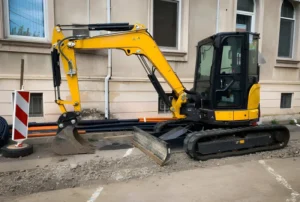
The right size depends on the task rather than a single weight category. A machine in the 1–2 tonne class may be appropriate for some shallow trenches and restricted residential spaces, while a 3–6 tonne machine may be better suited to deeper excavation, heavier ground or work requiring greater digging reach. These are indicative selection ranges, not universal specifications.
Use the following table as an initial guide.
| Approximate machine class | Potential applications | What to check before hiring |
| 1–2 tonnes | Small landscaping jobs, shallow service trenches and restricted garden access | Actual track width, available digging depth and stability |
| 2–3 tonnes | General residential excavation, drainage work and small utility trenches | Required depth, bucket dimensions and working clearance |
| 3–6 tonnes | Larger trenches, heavier excavation and more demanding ground conditions | Digging reach, ground pressure, transport dimensions and lifting limits |
| Above 6 tonnes | More substantial excavation where site access and working space allow | Whether a larger excavator is more appropriate than a mini excavator |
These are broad planning categories, not confirmed specifications for Upway Transport LLC’s available machines. Actual dimensions and capabilities vary by manufacturer, model, boom and dipper configuration, attachments and operating equipment.
The smallest machine is not automatically the most economical choice. If it needs more passes, cannot reach the trench bottom effectively or requires frequent repositioning, the apparent saving on rental cost may be offset by additional working time.
Likewise, hiring a larger excavator simply to gain digging capacity can create unnecessary access, transport and ground-loading problems.
The goal is to identify the smallest machine that can complete the required work within its rated operating limits and the site’s safety requirements.
2. How do you measure access for a mini excavator?
Machine width is often the first measurement to check when working in a villa compound, service passage, landscaped area or restricted construction site.
However, the width shown in a specification sheet does not always represent the machine’s full operating envelope.
Before confirming a rental, measure the entire access route, including gates, walls, doorways, corners, ramps and the area where the excavator must turn.
Machine width and retractable tracks
Some mini excavators have expandable tracks. The undercarriage can be narrowed for access and widened for working, subject to the manufacturer’s instructions.
For example, Caterpillar lists a track width of approximately 990 mm when retracted and 1,300 mm when expanded for its 301.7 CR mini excavator. Its listed digging depth with the standard stick is 2,350 mm. These figures describe that particular model and configuration, not mini excavators generally.
A narrow track setting can help a machine pass through a restricted entrance. It does not mean the excavator can necessarily work in that same narrow configuration. Follow the manufacturer’s requirements for track position during excavation.
Measure the following:
- Narrowest clear opening: Measure between the actual obstructions, not just the gate frame.
- Machine width: Confirm the full width in the intended travel configuration, including any protruding components.
- Headroom: Check overhead beams, canopies, pipes, cables and other obstructions.
- Turning clearance: Allow enough room to steer and position the excavator without striking walls or structures.
- Ground conditions: Check whether the access route can support the machine and its transport equipment.
Allow a practical clearance margin rather than selecting a machine that matches the opening exactly. The required margin depends on the route, operator visibility, surface conditions and manufacturer’s guidance.
Do not confuse machine width with working space
An excavator may pass through a 1.2-metre opening yet require considerably more space to position its boom, rotate the upper structure and place excavated material.
This matters particularly in narrow side passages. Measure both the entrance and the actual work area.
If the machine must excavate alongside a boundary wall, assess whether the boom can reach the trench without the tracks overhanging the edge or the counterweight striking the wall.
3. Why operating weight matters
Operating weight affects more than transport. It influences ground loading, manoeuvrability, stability and the conditions under which an excavator can work.
A lighter machine can be advantageous on restricted sites, but lower weight does not automatically make it suitable for weak ground, suspended slabs or underground structures.
Before choosing a machine, consider three factors.
Ground-bearing capacity. Check whether the soil, pavement, slab or temporary access surface can support the machine. The assessment should consider the machine’s weight, track contact area, movement and working loads.
Stability during excavation. Digging over the side, working near a trench edge or handling a heavy attachment can change the loads acting on the machine. Follow the manufacturer’s operating instructions and required working clearances.
Transport weight. The machine’s transport arrangement may include a bucket, attachment, fuel and other equipment. Confirm the actual transport configuration, carrier capacity, loading arrangements and applicable road requirements.
For projects inside buildings or on elevated structures, obtain a suitable assessment of the supporting structure before moving heavy equipment onto it. A compact excavator should never be assumed safe for a slab simply because it is smaller than a conventional excavator.
4. How much digging depth do you need?
Digging depth is one of the most important specifications when selecting an excavator for drainage, irrigation, foundations, and utility trenches.
The required depth should come from the approved design or project instructions, not from an estimate based on the machine’s size.
For example, a machine with a maximum digging depth of 2.35 metres may be appropriate for a particular trench if its geometry, ground conditions, and working arrangement allow it to reach the specified depth safely. That does not mean it can excavate every trench to that depth in every situation.
Maximum digging depth is a manufacturer-rated figure measured under specified conditions. Actual usability can be affected by boom and dipper configuration, bucket geometry, ground level, trench width and the position of the machine.
Check more than maximum digging depth
Before hiring, compare these measurements:
- Maximum digging depth: The manufacturer’s stated maximum vertical digging capability.
- Digging reach: The horizontal distance the excavator can reach at the relevant working position.
- Maximum digging height: Relevant when loading excavated soil into a suitable truck or placing material at a higher level.
- Dumping clearance: The clearance available to discharge material into a container or vehicle.
- Working position: Whether the excavator can reach the required area without operating too close to an edge or obstruction.
A deep trench may also require a wider working area, suitable protective measures and a planned method of access and egress. Choosing a machine with sufficient digging depth does not, by itself, establish that the excavation is safe.
If the trench is deep, narrow or close to existing structures, the excavation method and protective arrangements should be assessed by the responsible project team before work begins.
5. Choosing the right bucket for narrow trenches
Bucket selection affects excavation width, digging resistance, spoil volume and the amount of material removed on each pass.
A wider bucket is not always better. For a narrow utility trench, it may remove more soil than necessary, increase reinstatement work and make it harder to maintain the specified trench dimensions.
| Bucket type | Typical purpose | Main consideration |
| Narrow trenching bucket | Restricted-width trenches and selected utility work | Confirm the specified trench width and compatibility with the machine |
| General-purpose digging bucket | General soil excavation and material removal | Balance digging performance with the required excavation dimensions |
| Wider ditching or grading bucket | Shaping, levelling and selected drainage or finishing tasks | A wide bucket may not be suitable for a narrow trench |
| Other approved attachments | Specialised tasks, depending on the attachment | Check hydraulic compatibility, machine limits and the intended application |
Bucket dimensions and capacities vary by model and attachment. Do not assume that a bucket used on one excavator will fit another.
When trench dimensions are specified, compare the bucket’s cutting width with the design width. The final trench may be wider than the bucket because of soil conditions, digging technique and the required working clearance.
Also consider the material being excavated. Compact or difficult ground may require a different bucket configuration from loose soil, and an unsuitable attachment can reduce productivity or place unnecessary strain on the equipment.
For utility work, excavation dimensions should follow the approved design and relevant utility requirements. The objective is not simply to dig the narrowest possible trench; it is to create the required excavation without compromising the installation or surrounding ground.
6. What is tail swing, and why does it matter?
Tail swing is the movement of the excavator’s rear upper structure as it rotates. Depending on the machine design, the counterweight may extend beyond the track width during rotation.
This can create a clearance problem when working between walls, next to parked vehicles or beside an existing structure.
A zero-tail-swing or reduced-tail-swing design can help in confined spaces, but it does not mean the entire excavator can rotate without clearance. The boom, bucket, attachment and upper structure still need a suitable operating envelope.
Before choosing a machine, establish:
- How close the excavator will be to walls, fences or neighbouring structures.
- Whether the machine must rotate fully or can work within a limited arc.
- Whether the boom can reach the trench while the tracks remain on stable ground.
- Whether the counterweight or attachment could enter a pedestrian route or vehicle movement area.
- Whether a spotter, physical barrier or exclusion zone is needed to control nearby activity.
Do not select a machine solely because it is advertised as compact. Compare the manufacturer’s tail-swing information with the actual site layout.
7. Transport access: will the excavator reach the work area?
A mini excavator must be suitable for both the excavation and the journey to the work location.
A machine that fits through the site gate may still be difficult to deliver if the transport vehicle cannot enter, turn or unload safely.
For Dubai and other UAE projects, confirm the delivery route and unloading area before booking. Consider access restrictions, ramps, overhead clearance, surface strength and the space required for the transport vehicle.
The following details are particularly important:
- Transport dimensions: Overall length, width and height in the actual loading configuration.
- Transport weight: The combined load as transported, checked against the carrier’s rated capacity and applicable requirements.
- Loading and unloading: Adequate room and suitable arrangements for safely loading and unloading the machine.
- Site entrance: Whether the carrier can approach and leave without blocking access or creating a hazard.
- Final positioning: Whether the excavator can move from the unloading point to the excavation without crossing unsuitable ground.
For sites with underground parking, basement access or low overhead structures, confirm the relevant clearances and load restrictions rather than relying on the machine’s general dimensions.
It is also worth agreeing on the delivery and collection arrangements with the rental provider before the work starts. Restricted access or an unsuitable unloading area can create delays even when the excavator itself is correctly sized.
8. Underground utilities: what to check before digging
Selecting a compact excavator does not remove the risks associated with buried infrastructure. A small machine can still damage electrical cables, water pipes, telecommunications lines, gas infrastructure or drainage systems.
Before excavation begins, the responsible project team should identify underground services, confirm the applicable permissions and establish a safe excavation method.
For work in Dubai, the required approvals and utility coordination depend on the location, asset owner and type of work. Confirm the applicable process with the relevant authorities and service providers rather than assuming one permit covers every site.
A practical utility-checking process
Step 1: Review available records. Obtain current utility drawings and approved project information. Treat drawings as planning information, not proof that every service is accurately positioned.
Step 2: Coordinate with the relevant utility owners. Follow their procedures for locating, protecting and working near existing services.
Step 3: Arrange suitable detection and verification. Use appropriate locating equipment and competent personnel. Where required, establish the service’s position through an approved safe verification method before mechanical excavation approaches it.
Step 4: Mark the work area. Make the identified routes and restricted zones clear to the operator and ground crew. Communicate any uncertainty before excavation starts.
Step 5: Follow the approved excavation method. Use mechanical digging only where permitted by the site plan and utility owner’s requirements. Near services, the required method may involve controlled excavation or non-mechanical techniques.
Step 6: Protect exposed services. Follow the relevant utility owner’s instructions and the project’s approved protection arrangements while the excavation remains open.
The US Occupational Safety and Health Administration’s excavation standard, 29 CFR 1926.651, provides a useful general technical reference for identifying underground installations, determining their exact location as excavation approaches and protecting exposed services. It is a US standard, not a substitute for applicable UAE requirements.
Why machine size still matters around utilities
Machine dimensions and controls affect how precisely an operator can position the excavator, but a smaller excavator does not automatically make digging near a service safe.
For a trench running alongside an existing cable route, the correct machine may be one that can reach the permitted excavation area while keeping its tracks, blade and working equipment within the approved boundaries. The excavation method must still account for the service’s verified position and the required clearance.
If the utility location is uncertain, stop and resolve that uncertainty before continuing mechanical excavation.
9. Mini excavator selection for common site situations
Different projects place different demands on the machine. The following examples illustrate how to assess the requirements; they are not descriptions of completed Upway projects.
Villa side passage or garden
Start by measuring the narrowest entrance and the available turning space. A smaller machine with retractable tracks or reduced tail swing may be worth considering if the exact model fits the route. Check the ground surface, nearby walls and landscaping before delivery.
Drainage or water-line trench
Establish the specified depth, width, trench length and spoil-removal plan. Choose the machine and bucket together, then check the approved excavation method and underground service locations.
Warehouse or industrial service area
Measure access through gates and around stored materials. Assess pavement or slab loading, overhead obstructions, vehicle movements and the space needed to rotate the machine without entering active work routes.
Small foundation excavation
Compare the design depth and excavation dimensions with the machine’s rated digging geometry. Consider ground stability, adjacent foundations, spoil placement and whether the proposed machine can work without approaching an unsupported edge.
In each situation, the best choice depends on verified dimensions and working conditions rather than the project name alone.
10. Common mini excavator sizing mistakes
A few checks made before delivery can prevent avoidable problems during excavation.
| Common mistake | Why it causes problems | Better approach |
| Choosing by operating weight alone | Weight does not confirm access width or digging geometry | Compare the actual machine dimensions and rated capabilities |
| Measuring only the entrance gate | The excavator may not fit through a corner or turn into the work area | Measure the complete access route and operating space |
| Checking digging depth but not reach | The machine may not reach the required part of the trench from a safe position | Review digging-depth and reach diagrams |
| Using an oversized bucket | The trench may exceed its design width or require more reinstatement | Match the bucket to the specified excavation dimensions |
| Ignoring tail swing | The counterweight may strike a wall, vehicle or nearby worker | Check the full working envelope and control access |
| Assuming the site surface can support the machine | Pavement, slabs or ground may be unsuitable for the imposed loads | Arrange an appropriate ground or structural assessment |
| Relying only on utility drawings | The actual position of a service may differ from the drawing | Follow utility-owner procedures and verify locations |
| Forgetting transport clearance | The excavator or delivery vehicle may not reach the unloading area | Confirm transport dimensions, route and unloading arrangements |
The most effective selection process is to resolve access, digging and safety constraints before comparing rental prices.
11. A pre-rental checklist for contractors
Use this checklist when preparing a mini excavator rental enquiry.
Site-readiness checklist
Site access
Narrowest opening, route width, overhead clearance and turning space.
Required excavation
Trench depth, width, length, reach and intended application.
Machine configuration
Operating weight, track width, tail swing and boom/dipper configuration.
Bucket and attachments
Required bucket width, attachment compatibility and hydraulic requirements.
Ground conditions
Soil type, slope, pavement or slab capacity and proximity to excavation edges.
Underground utilities
Current drawings, utility-owner coordination, required approvals and verified service locations.
Delivery and collection
Transport dimensions, unloading area, carrier access and planned hire period.
Site controls
Operator arrangements, exclusion zones, excavation protection and approved working method.
Reset checklist
Completing the checklist will not replace the required engineering assessments, utility approvals or manufacturer operating instructions. It helps identify the information that must be resolved before a machine is selected and dispatched.
12. What information should you give the rental provider?
A useful enquiry describes the work and its constraints rather than simply requesting a one-tonne, three-tonne or five-tonne excavator.
Provide the following information where available:
- Project location: Site address or area in Dubai or elsewhere in the UAE.
- Application: Utility trenching, drainage, landscaping, foundation work or another specific task.
- Access measurements: Narrowest clear width, overhead height and turning limitations.
- Excavation requirements: Required depth, width, length and working reach.
- Ground conditions: Soil type, surface condition, slope and any known load restrictions.
- Utility information: Known underground services, approvals and any restrictions on mechanical excavation.
- Attachments: Required bucket dimensions or other approved equipment.
- Rental duration: Expected start date, working period and likely collection date.
- Operating arrangements: Whether you require an operator and any relevant site restrictions.
If the precise machine size is uncertain, share the site measurements and excavation requirements first. The rental provider can then help identify a suitable available option for further technical confirmation.
For equipment options, rental arrangements and project-specific enquiries, visit Upway Transport LLC’s mini excavator rental page.
Frequently asked questions
What is the best mini excavator size for a narrow access area?
The best size is the smallest machine that meets the required digging and working limits while fitting through the complete access route. Check the actual track width, machine height, tail swing, turning space and ground conditions before confirming the model.
Can a mini excavator dig a 2-metre-deep trench?
Some mini excavators have a rated digging depth above 2 metres, while others do not. Confirm the specific model’s digging geometry and assess whether it can excavate the required trench safely under the planned site conditions.
Does a smaller excavator always have less ground impact?
Not necessarily. Ground impact depends on operating weight, track contact area, load distribution, movement and surface conditions. Assess the actual machine and supporting surface rather than relying on its size classification.
Is zero tail swing necessary for narrow trenching?
Not in every situation. It can help when rear clearance is restricted, but suitability depends on the entire working envelope, including the boom, bucket and attachment. A reduced-tail-swing machine still needs adequate clearance and an appropriate exclusion zone.
Which bucket is best for utility trenches?
Choose a bucket compatible with the excavator and the approved trench dimensions. A narrow trenching bucket may suit restricted-width excavation, while other tasks may need a general-purpose or grading bucket. Bucket selection must also account for the material and approved excavation method.
What should be checked before digging near underground utilities?
Review current drawings, coordinate with the relevant utility owners, confirm the applicable approvals, verify service locations using suitable methods and follow the approved excavation procedure. Do not assume that a compact machine makes mechanical excavation near a buried service safe.
What information is needed to hire a mini excavator in Dubai?
Provide the project location, access measurements, required trench dimensions, ground conditions, attachment requirements and rental period. Include known underground utilities and any restrictions on delivery, unloading or operation.
Final thoughts
Choosing a mini excavator is a matter of matching the machine to the real conditions on site. Width determines whether it can gain access; operating weight affects ground suitability and transport; digging geometry determines whether it can reach the required excavation; and bucket selection and tail swing influence how it works in restricted spaces.
For utility trenches, these considerations must sit alongside underground service identification, approved excavation methods and the relevant site safety arrangements.
Before arranging a rental, gather the site measurements and excavation requirements, then confirm the exact machine configuration against its manufacturer specifications. If you need help assessing equipment options for your project, contact Upway Transport LLC with the details of your site and intended work.