A telescopic boom lift is generally the better choice when you need long, direct horizontal outreach to an elevated work area. An articulating boom lift is usually more suitable when workers must reach up and over obstacles, such as structural beams, rooftop equipment, pipework or warehouse fixtures.
The right choice depends on more than the height of the job. You also need to consider the distance between the machine and the work area, the height and position of obstacles, the available space for positioning, ground conditions and the combined weight of workers, tools and materials.
For contractors and facility managers planning work at height in Dubai and across the UAE, understanding these differences helps avoid hiring a machine that reaches the required height but cannot safely access the actual work position.
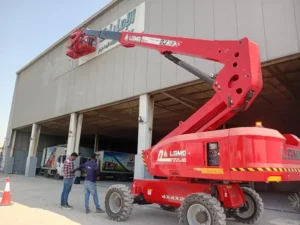
What Is the Difference Between a Telescopic and an Articulating Boom Lift?
A telescopic boom lift uses a straight, extendable boom to move the platform towards the work area. An articulating boom lift has hinged sections that allow the boom to bend and change direction, helping the platform reach over or around obstacles.
Telescopic boom lift — straight-line reach
Best suited to elevated work where a direct route to the target is possible and the machine needs to reach across an open area. Common applications include steel erection, exterior construction, façade installation and industrial maintenance.
Also called a straight boom lift or telescoping boom lift.
Articulating boom lift — flexible positioning
Best suited to work areas where a straight boom path is blocked by building elements, machinery, roof edges or other obstructions. Its hinged sections allow the platform to move up, over and around obstacles within the machine’s permitted working envelope.
Also called a knuckle boom lift or articulated boom lift.
Neither type is automatically superior. A telescopic boom can provide greater horizontal outreach on many models, while an articulating boom offers more flexibility when the access route is complicated. The exact capability depends on the machine’s design and manufacturer specifications.
How Do Working Height, Horizontal Outreach and Up-and-Over Reach Differ?
These three measurements describe different aspects of a boom lift’s capability. Understanding them is essential because a machine can have sufficient working height but still fail to reach the intended work position.
- Working height
Working height is the estimated height at which a person can perform a task from the platform. Manufacturers commonly calculate it using platform height plus an assumed operator reach, often around 2 metres. Check the manufacturer’s definition before comparing models.
For example, a machine advertised with a 20-metre working height does not necessarily place its platform 20 metres above ground.
- Horizontal outreach
Horizontal outreach is the horizontal distance the platform can reach away from the machine’s relevant reference point, as defined by its manufacturer. It matters when the lift cannot be positioned directly beneath the work area.
A long boom does not guarantee maximum outreach at every height. The permitted working envelope, boom angle, platform load and machine configuration all affect the available reach.
- Up-and-over reach
Up-and-over reach describes the ability to raise the boom above an obstruction before moving the platform across it. Articulating boom lifts are often well suited to this task because their hinged sections can change direction.
The obstacle’s height, width and position must be considered alongside the lift’s permitted working envelope. A machine may reach above a wall but still be unable to position its platform safely on the other side.
The practical lesson: Do not select a boom lift using working height alone. Confirm the platform’s actual required position, horizontal distance and clearance around obstacles. Manufacturer reach diagrams are more useful than a single maximum-height figure when planning a complex access job.
Telescopic vs Articulating Boom Lift: Comparison Table
| Selection factor | Telescopic boom lift | Articulating boom lift |
| Boom movement | Extends mainly in a straight line | Hinged sections change direction |
| Typical advantage | Direct, long horizontal outreach | Access over or around obstacles |
| Open construction sites | Often a strong option | Suitable when positioning is more complex |
| Rooftop pipework and services | Depends on whether a direct approach is possible | Often preferable where obstacles block a direct approach |
| Façade and structural work | Useful for reaching distant work areas | Useful where ledges or structural elements obstruct access |
| Confined work areas | Requires sufficient room for positioning and movement | Can offer greater positioning flexibility, depending on model |
| Platform positioning | Direct approach to the work area | Multiple boom angles for complex access |
| Maximum working height | Often higher on comparable product ranges, but model-dependent | Varies by model and configuration |
| Horizontal outreach | Often greater on comparable models | Varies; typically less than a comparable straight boom |
| Final selection | Based on the reach chart, capacity and site layout | Based on the reach chart, articulation and site layout |
These are general design tendencies, not universal specifications. Some articulated models have substantial outreach, and some telescopic models can be configured with a jib that improves positioning. Compare actual manufacturer specifications rather than assuming that every machine in one category performs the same way.
When Should You Choose a Telescopic Boom Lift?
Choose a telescopic boom lift when the main challenge is reaching a work area across a relatively open space, particularly when the machine must remain some distance from the structure.
Its straight, extending boom is useful when the target is accessible along a relatively direct path and the site provides enough room to position and operate the machine.
Typical applications
- Steel erection: Accessing elevated steelwork and connection points during structural construction.
- Building façades: Reaching exterior panels, cladding, structural components and other work areas from a suitable ground position.
- Industrial maintenance: Accessing elevated equipment, pipework or structures where a direct approach is available.
- Infrastructure work: Reaching sections of elevated structures from an accessible working area.
- Large construction sites: Positioning workers at height where there is sufficient room for machine movement.
Example: Installing exterior steelwork
Imagine a contractor installing steel components on a commercial building. The work area is elevated, and the ground in front of the structure is sufficiently open to position the lift away from the building.
A telescopic boom lift may be appropriate because it can extend directly towards the work area without needing to bend its boom around intermediate obstructions.
However, the required platform position must still fall within the machine’s approved working envelope. The contractor must also account for the platform load, ground conditions, overhead hazards and space required to manoeuvre the chassis.
When a telescopic boom may not be the best option: If a roof projection, structural beam or other obstacle blocks the direct route, the platform may not reach the work point even when the advertised working height is sufficient. An articulating boom or a different access solution may be more appropriate.
When Should You Choose an Articulating Boom Lift?
Choose an articulating boom lift when the platform needs to move around obstacles or approach a work area from a particular direction. Its hinged boom sections provide alternative movement paths that a straight boom cannot reproduce.
Typical applications
- MEP installation: Accessing mechanical, electrical and plumbing services around existing building components.
- Rooftop maintenance: Reaching equipment positioned behind parapets or other obstructions, where the working envelope permits.
- Warehouse maintenance: Accessing elevated services, lighting and structural elements around fixed installations.
- Building refurbishment: Reaching work points around ledges, canopies or sections of an existing structure.
- Industrial facilities: Positioning workers around machinery, pipework and other equipment that restricts a direct approach.
Example: Maintaining rooftop air-conditioning equipment
Suppose a facility manager needs to inspect or maintain rooftop equipment located behind a parapet wall, with pipework and other services restricting the approach.
A telescopic boom may be unable to reach the required work position along a straight path. An articulating boom could offer a more suitable route by raising one section and bending another to place the platform beyond the obstruction.
That does not automatically make the articulated machine suitable. The operator must be able to maintain the required clearances, and the platform must reach the task without exceeding the permitted boom configuration or load limits.
When an articulating boom may not be the best option: If the task requires substantial horizontal reach across a large open area, a telescopic boom may provide a more suitable working envelope. The specific models must be compared before deciding.
How Do Obstacles Affect Boom Lift Selection?
The key question is not simply whether an obstacle exists. It is whether the boom can travel around or above it while keeping the platform in a safe, workable position.
Consider these common site conditions:
Open ground in front of a building
A telescopic boom is worth considering if the platform can extend directly towards the target. Check the required outreach and working height together.
A parapet wall or roof edge
An articulating boom may help the platform reach beyond the obstruction. Confirm the necessary up-and-over clearance and the manufacturer’s reach diagram.
Structural beams and installed services
An articulating boom may provide more positioning options, but the entire boom path must be checked for interference with beams, cables, pipes and other structures.
Very narrow access or restricted ground space
A conventional boom lift may not fit through the entrance or have sufficient room to operate. A suitable spider lift may be worth assessing, subject to its reach, stabiliser footprint and ground requirements.
For complex access, consider the full three-dimensional path from the machine’s starting position to the work point. The boom, platform and operator need clearance throughout the movement, not just at the final position.
What About Ground Conditions and Machine Positioning?
The best boom design is only useful if the machine can be safely positioned and operated at the site.
Before selecting equipment, assess the following:
- Ground bearing capacity: Confirm that the surface can support the machine’s operating weight and imposed loads. Underground services, suspended slabs and recently backfilled areas may require particular attention.
- Slope and level: Check the manufacturer’s permitted operating slope and levelling requirements. Do not assume that a rough-terrain machine can operate safely on every uneven surface.
- Available working area: Account for the chassis, turning movements, boom swing, counterweight or tail swing where applicable, and any required exclusion zone.
- Access route: Measure gate openings, doorways and narrow passages. Compare them with the machine’s transport dimensions and any restrictions along the route.
- Overhead hazards: Identify power lines, roof structures, cables, pipes and other obstructions before positioning the lift.
- Surface protection: Consider whether the floor or finished surface needs protection from tyres, tracks or stabilisers.
Articulating boom lifts can offer flexible positioning, but they are not automatically smaller or suitable for confined sites. Telescopic machines can also be appropriate in restricted locations when the selected model and access route allow it.
Where a conventional boom lift cannot enter the site, a spider lift may be an alternative. Upway lists spider lift options with different working heights and track-mounted configurations on its equipment services page. Confirm the specifications and suitability of the actual machine before hiring it.
How Does Platform Capacity Affect the Choice?
Platform capacity is the maximum permitted load the platform can carry under the applicable operating conditions. It includes the people, tools and materials being lifted, not just the weight of the operators.
A machine’s stated maximum capacity should never be assumed to apply at every boom angle or outreach. Depending on the model, the permitted capacity may vary with the working envelope and operating configuration.
Before choosing a lift, establish:
- How many workers will be in the platform.
- The combined weight of workers, tools and materials.
- Whether the work requires materials that are awkward or difficult to handle.
- Whether the platform can be positioned without exceeding its permitted capacity.
- Whether the manufacturer imposes additional restrictions for the planned configuration.
For example, an articulating boom may solve an obstacle-access problem, but that does not mean it can safely carry the required load at the intended reach. The selected machine must satisfy both the access requirements and the load limits.
Never use the platform to carry additional materials beyond its rating or use the boom as a lifting crane unless the equipment is specifically designed and approved for that purpose. Follow the manufacturer’s operating instructions and applicable site safety procedures.
How to Choose the Right Boom Lift for a Project in Dubai
The most reliable way to select a machine is to work backwards from the exact location where the job must be performed.
Step 1: Identify the actual work point
Record the required platform position, not just the height of the building. Include the elevation, distance from the proposed machine position and any obstacles between them.
Step 2: Measure height and outreach
Establish the required platform height and horizontal distance. Use the manufacturer’s definition of working height when comparing equipment.
Step 3: Map the access route
Determine whether the platform can approach directly or needs to travel up and over an obstacle. This is the main factor in deciding between straight and articulated boom designs.
Step 4: Check site conditions
Confirm ground conditions, slope, access dimensions, overhead hazards, available manoeuvring space and any floor-loading restrictions.
Step 5: Verify the specific model
Review the manufacturer’s working envelope, rated capacity, dimensions, power source, permitted slope and operating restrictions. Confirm that the complete task can be performed within those limits.
Quick decision guide
| Your main requirement | Equipment worth assessing first |
| Long, direct reach towards an elevated work area | Telescopic boom lift |
| Reaching up and over fixed obstacles | Articulating boom lift |
| High work with limited room for positioning | Articulating boom lift, subject to dimensions and reach |
| Large open site with distant work points | Telescopic boom lift |
| Narrow entrance or restricted access route | Compact boom lift or suitable spider lift |
| Difficult ground or uncertain load-bearing conditions | Site assessment and machine-specific suitability check before selection |
This is a preliminary selection guide, not a substitute for checking the actual machine’s reach chart and site conditions.
Common Mistakes When Comparing Boom Lifts
A few selection errors can lead to hiring equipment that does not fit the job or cannot reach the intended work position.
Choosing by maximum working height alone. A lift may reach the required elevation but fall short horizontally. Compare height and outreach at the same working position.
Ignoring the obstacle’s height. A platform that can reach beyond a wall may not have enough clearance to rise above it first. Check the complete movement path.
Assuming all articulated booms are compact. Boom geometry, chassis dimensions, tail swing and turning requirements vary by model. Check the actual transport and operating dimensions.
Overlooking the ground or floor. Machine weight, wheel loads, slope and stabiliser reactions may affect whether the proposed position is suitable. A visual inspection alone does not establish load-bearing capacity.
Forgetting the platform load. Workers, tools and materials all contribute to the total load. Confirm the permitted capacity for the intended operating configuration.
Measuring the site only from the ground. Photographs and ground measurements help, but they may not reveal overhead interference or the full clearance required for boom movement. Use a site assessment when the access route is complicated.
Assuming the larger machine is always the better option. A longer boom may add no practical benefit if the site cannot accommodate the chassis or the platform needs to move around obstacles.
Safety Considerations Before Hiring a Boom Lift
Both telescopic and articulating boom lifts are mobile elevating work platforms (MEWPs). Safe operation depends on selecting the correct machine, assessing the site, inspecting the equipment and following the manufacturer’s instructions.
Before work begins:
- Confirm that the selected machine is suitable for the task, ground conditions and access route.
- Check the manufacturer’s operating manual, load limits, working envelope and slope restrictions.
- Identify overhead power lines and other obstructions, and establish appropriate clearances and controls.
- Inspect the machine and platform controls in accordance with the applicable procedures.
- Ensure operators are trained and authorised for the equipment and task.
- Establish suitable fall protection, exclusion zones and emergency lowering arrangements in accordance with the manufacturer and applicable requirements.
- Stop work if wind, weather, ground conditions or site changes make the operation unsafe.
For work near power lines, follow the applicable UAE requirements and the relevant utility’s safety instructions. Do not rely on the boom’s reach or insulation assumptions as protection against electrical hazards.
A machine that can physically reach the work area is not necessarily safe to operate there. If the proposed setup is uncertain, obtain a competent site assessment before confirming the rental.
Renting a Telescopic or Articulating Boom Lift From Upway Transport LLC
Upway Transport LLC lists both articulated and telescopic boom lift options on its Boom Lift Rental Dubai page. Its published equipment range includes articulated models listed at 13 m, 16 m, 20 m, 21 m, 26 m and 43 m, and telescopic models listed at 16 m, 22 m, 28 m, 40 m, 48 m and 57 m. These are the heights shown on the service page; the precise measurement basis and availability of individual models should be confirmed before hiring.
If you are unsure which type is appropriate, start with the work position and access conditions rather than choosing a machine by name or height alone.
When contacting Upway, provide:
- Project location: The site address in Dubai or elsewhere in the UAE.
- Required working height: The estimated height of the task and, if known, the required platform elevation.
- Horizontal distance: How far the platform must reach from the proposed machine position.
- Obstacle details: The height and position of walls, beams, roof edges, pipes or machinery.
- Site access: Entrance width, available manoeuvring room and any restrictions on machine dimensions.
- Ground conditions: Whether the lift will operate on a slab, paved area, compacted ground or another surface.
- Platform load: The number of workers and approximate combined weight of tools and materials.
- Rental schedule: The required dates and expected rental duration.
Photos of the work area and a simple site sketch can help explain difficult access requirements. The final selection should be checked against the actual machine specifications and site conditions.
For model options and rental enquiries, visit Upway Transport’s boom lift rental service.
Frequently Asked Questions
Is a telescopic or articulating boom lift better?
Neither is universally better. A telescopic boom is often preferable for long, direct outreach, while an articulating boom is generally more suitable for reaching around or over obstacles. The right choice depends on the required working position, machine specifications and site layout.
Can an articulating boom lift reach over a building or wall?
It may be able to, depending on the obstacle’s dimensions and the machine’s working envelope. The required elevation, horizontal distance, boom angles and platform position must all be checked against the manufacturer’s specifications.
Does a telescopic boom lift have more horizontal outreach?
Many telescopic models offer greater horizontal outreach than comparable articulated models. However, this is not a universal rule. Compare the reach charts of the specific machines being considered.
Is working height the same as platform height?
No. Platform height measures the elevation of the platform above the reference ground level. Working height is an estimated reach figure that commonly includes an assumed operator reach above the platform. Manufacturers may use different definitions, so confirm the stated measurement.
Can a boom lift operate on uneven ground?
Some models are designed for rough-terrain applications, but every machine has operating limits. Check the manufacturer’s slope and ground requirements, as well as the surface’s load-bearing capacity. Do not assume that four-wheel drive or rough-terrain tyres make any surface safe.
When should I consider a spider lift instead?
Consider a spider lift when access is particularly narrow, the machine must pass through restricted entrances, or the work requires a compact tracked platform with stabilisers. Suitability still depends on the working height, outreach, stabiliser footprint, floor loading and site conditions. Review Upway’s spider lift rental options for further information.
What details are needed to request a boom lift rental quotation?
Provide the project location, required height, horizontal outreach, obstacle dimensions, site access restrictions, ground conditions, platform load and rental dates. These details help narrow down the appropriate machine before confirming availability and price.
Final Recommendation
The main difference between telescopic and articulating boom lifts is how they position the platform. A telescopic boom is generally suited to direct, long-distance access, while an articulating boom offers greater flexibility when the platform must travel up and over obstacles.
Before hiring, verify three things: the platform can reach the actual work point, the machine can be safely positioned on the site, and the required load remains within its permitted limits. That approach is more reliable than choosing a lift based on maximum height alone.
If you have a project in Dubai or elsewhere in the UAE, share the required work height, distance, obstacle details and site access conditions with Upway Transport LLC to help identify a suitable machine for assessment.