Access Solutions for Fire Fighting and Plumbing Installations
Introduction
Fire safety systems and plumbing infrastructure require work at heights—on building facades, rooftops, upper floors, and in confined spaces. Whether you’re installing fire suppression lines, positioning hydrants, running copper lines across a high-rise, or servicing HVAC-integrated plumbing systems, accessing these areas safely is a critical challenge that directly impacts project timelines, labour costs, and worker safety.
Choosing the wrong access equipment can lead to costly delays, worker injuries, and regulatory compliance issues. Conversely, selecting the right platform for the job—one that matches your height requirements, terrain conditions, and safety standards—streamlines installation work and reduces overall project costs.
This guide explores the access equipment solutions most suitable for fire fighting and plumbing installation projects across Dubai and the UAE, helping contractors make informed rental decisions that prioritize both productivity and safety.
Direct Answer:
Best Access Equipment for Fire Fighting and Plumbing Installations
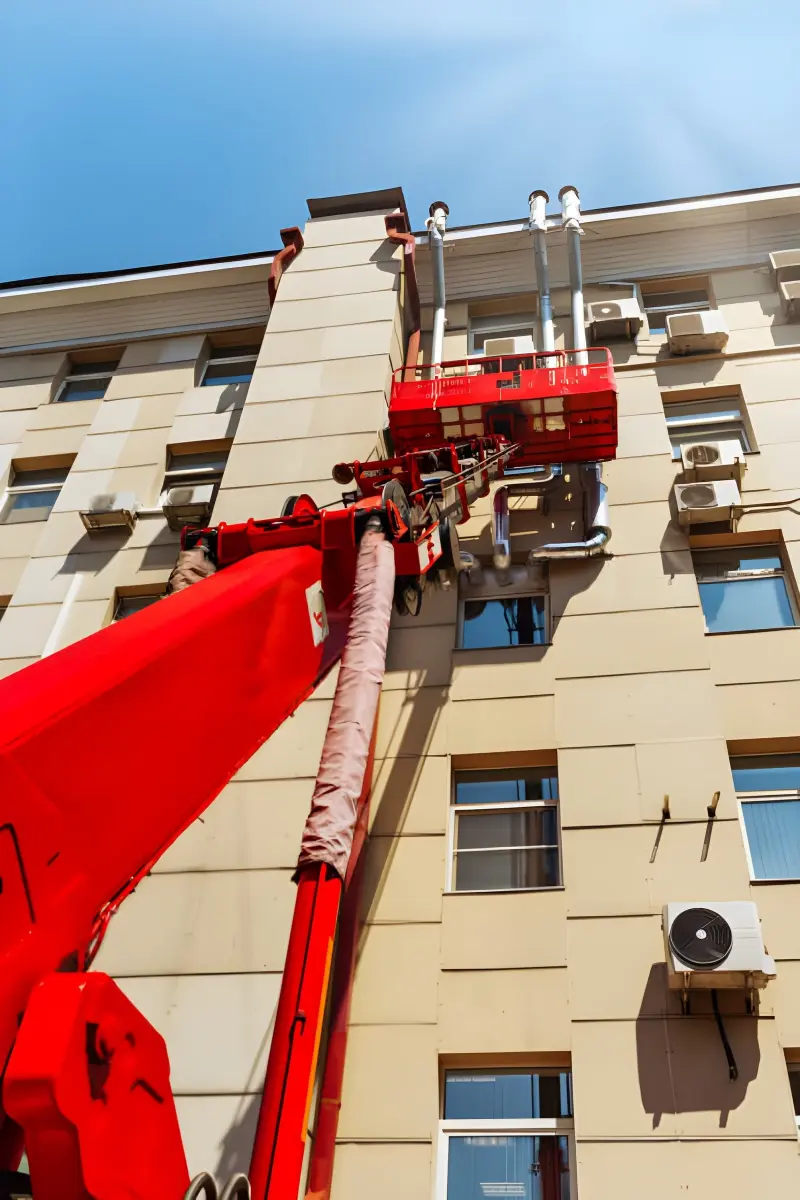
For fire fighting and plumbing installations, boom lifts and scissor lifts are the most commonly used access platforms. Boom lifts (particularly articulating models) are preferred for reaching high points, navigating obstacles, and working on building facades where workers need to position systems at specific elevations. Scissor lifts work well for vertical stacking installations in warehouses or industrial facilities, while spider lifts excel in confined spaces—common in older buildings or malls where side-access is limited.
For working heights between 10m and 30m, articulating boom lifts offer the best combination of reach, stability, and manoeuvrability. Telescopic boom lifts are ideal when you need to cover longer distances horizontally before elevating. Personnel lifts are suitable for precise, single-point work, while mobile cranes support the delivery and positioning of heavy water tanks and fire suppression equipment.
The choice depends on your specific project: building height, ground conditions, indoor vs. outdoor work, load requirements, and local regulations in your UAE service area.
Understanding Access Challenges in Fire Fighting and Plumbing Work
The Height and Reach Problem
Fire fighting systems require access to rooftops, upper-floor equipment rooms, and external building facades. Plumbing installations—particularly in high-rise residential and commercial buildings—need technicians positioned at multiple elevations to run supply and drainage lines vertically and horizontally.
Traditional methods—scaffolding, ladders, or suspended working platforms—are labour-intensive and often unsuitable for the precision positioning required in these trades. Access platforms provide a safer, faster, and more cost-effective alternative.
Site-Specific Constraints
Many fire fighting and plumbing projects occur in challenging environments:
- Tight indoor spaces (equipment rooms, plant rooms, parking levels)
- Existing building facades with obstructing features (AC units, signage, windows)
- Rooftop installations with uneven surfaces or limited landing space
- Multi-level buildings requiring work at 5m, 12m, 18m, and 25m+ simultaneously
- Confined outdoor areas (mall courtyards, narrow lanes, industrial sites)
These constraints eliminate simple ladder work and standard scaffolding, making powered access platforms essential.
Safety and Regulatory Compliance
Fire fighting and plumbing work in the UAE must comply with:
- DOSH regulations (Department of Occupational Safety & Health standards)
- ADWEA guidelines (for water system installations in Abu Dhabi)
- DM regulations (Dubai Municipality building codes)
- International fall protection standards (IPAF, HSE guidance)
- Equipment certification requirements for work above 2m
Using the correct access platform—one certified for your specific working height and load—ensures compliance and reduces liability.
Access Equipment Options for Fire Fighting and Plumbing Installations
Articulating Boom Lifts: The Versatile Choice
What They Are
Articulating boom lifts have a multi-section arm that bends and extends, allowing workers to navigate around obstacles and reach points that would be impossible from a straight vertical lift.
Why They’re Ideal for Fire Fighting and Plumbing
- Obstacle navigation: Reach around building features, existing plant equipment, and structural columns
- Precise positioning: Workers can position themselves at exact angles to install systems correctly
- High working heights: Most models reach 15m–36m+, suitable for multi-storey buildings common across Dubai and the UAE
- Compact footprint: Fits in tight spaces—critical for congested construction sites
Common Models and Specifications
- 14m articulating boom lifts: Platform height 12m–14m, ideal for 3–4 storey buildings, interior plant rooms
- 20m articulating boom lifts: Platform height 18m–20m, suited for mid-rise (6–7 storey) installations
- 28m articulating boom lifts: Platform height 26m–28m, for high-rise buildings (8–10+ storeys)
Load Capacity
Standard articulating boom lifts carry 200–300 kg in the platform, adequate for one or two technicians plus tools and equipment (piping segments, test equipment, fire suppression components).
Indoor vs. Outdoor Use
Most articulating boom lifts are electric or hybrid—essential for indoor use in malls, hospitals, and apartment buildings. Diesel models suit outdoor rooftop and facade work. Some platforms offer both power options depending on your project.
Project Applications
- Fire suppression line installation on building facades
- Roof-mounted fire tank positioning and plumbing connections
- High-rise plumbing valve installations and maintenance access
- HVAC-integrated plumbing system routing
- Water line installation across multiple building levels
- Equipment room access for system integration and testing
Cost Factors
Rental costs typically range from AED 400–650 per day for a 14m model, and AED 700–1,200 per day for 20m–28m models in Dubai. Multi-week rentals offer 30–40% discounts. Transport and setup fees apply separately.
Telescopic Boom Lifts: Maximum Horizontal Reach
When to Choose Telescopic Over Articulating
If your project requires maximum horizontal outreach before elevating—such as positioning fire suppression equipment mounted on building overhangs or working across wide courtyards—a telescopic boom is more efficient. The straight-arm design reaches further horizontally than an articulating boom at the same working height.
Common Applications
- Installing fire suppression systems on building overhangs or cantilevers
- Plumbing work on facade-mounted rain-water systems
- Roof-edge equipment positioning (water tanks, fire pumps)
- Wide-courtyard work in shopping malls or industrial parks
Specifications
- 17m telescopic: Horizontal reach to 13m, platform height 15m
- 25m telescopic: Horizontal reach to 18m, platform height 23m
- 40m telescopic: Horizontal reach to 30m, platform height 38m+
Working on Soft Ground
Telescopic booms have larger footprints than articulating models. If your project is on grass, asphalt requiring protection, or soft soil, consider outriggers and ground protection plates—included in rental packages.
Scissor Lifts: Stable, Vertical Access
Best For
Scissor lifts excel in industrial and warehouse settings where you need stable, vertical access—ideal for plumbing work inside warehouses, industrial plants, or logistics facilities. They’re also effective for parking level and floor-by-floor installations where obstacle navigation isn’t required.
Advantages
- Very stable platform: Minimal bounce or sway—perfect for precision work
- High load capacity: Up to 1,000 kg on some models (suitable for installing heavy components)
- Compact when lowered: Fits through standard doorways (some models)
- Electric options: Ideal for indoor industrial environments (hospitals, cleanrooms, food facilities)
Common Models
- Compact scissor lifts (6m–8m working height): Maneuverable indoors
- Standard scissor lifts (10m–15m working height): Mid-level industrial work
- Heavy-duty scissor lifts (up to 20m+): Warehouse and large facility installations
Limitations for Fire Fighting Work
Scissor lifts cannot navigate obstacles and don’t provide horizontal reach, making them unsuitable for facade work or installations requiring access around building features.
Spider Lifts: Compact and Intelligent
The Advantage in Confined Spaces
Spider lifts combine the reach of a boom platform with an exceptionally compact footprint. Their narrow tracks and articulating arm make them ideal for confined spaces, narrow corridors, and tight courtyards common in older UAE buildings and congested malls.
When to Rent a Spider Lift
- Installing fire suppression systems in older buildings with narrow access points
- Plumbing work in apartment buildings with limited courtyard access
- Equipment installation in shopping malls with restricted side access
- Retrofitting systems in heritage or heritage-listed buildings
Specifications
Most spider lifts reach 16m–18m working height with a platform width of just 0.7m–0.9m, allowing passage through standard doorways and narrow alleyways.
Cost
Spider lifts are specialized equipment, typically costing AED 800–1,500 per day—higher than standard boom lifts due to their precision mechanics and compact design.
Personnel Lifts: Single-Point Precision Work
Application in Fire Fighting and Plumbing
Personnel lifts (also called vertical mast lifts) are small, self-propelled platforms for one or two workers. They’re useful for precise, single-location tasks:
- Installing individual fire alarm components or sprinkler heads at specific points
- Connecting isolated plumbing fixtures or valves at high elevations
- Testing and commissioning equipment at elevated positions
Limitations
Personnel lifts typically reach only 6m–15m and are slower than boom platforms—suitable only for targeted work, not full-project access.
Comparing Access Equipment for Fire Fighting and Plumbing Projects
| Factor | Articulating Boom | Telescopic Boom | Scissor Lift | Spider Lift | Personnel Lift |
| Best for obstacle navigation | ⭐⭐⭐⭐⭐ | ⭐⭐ | ❌ | ⭐⭐⭐⭐⭐ | ⭐⭐⭐ |
| Horizontal reach | ⭐⭐⭐ | ⭐⭐⭐⭐⭐ | ❌ | ⭐⭐⭐ | ⭐ |
| Indoor use | ⭐⭐⭐⭐ | ⭐⭐ | ⭐⭐⭐⭐⭐ | ⭐⭐⭐⭐ | ⭐⭐⭐⭐⭐ |
| Platform stability | ⭐⭐⭐⭐ | ⭐⭐⭐ | ⭐⭐⭐⭐⭐ | ⭐⭐⭐ | ⭐⭐⭐ |
| Load capacity | ⭐⭐⭐ | ⭐⭐⭐ | ⭐⭐⭐⭐⭐ | ⭐⭐ | ⭐⭐ |
| Confined space suitability | ⭐⭐ | ⭐ | ⭐⭐ | ⭐⭐⭐⭐⭐ | ⭐⭐⭐⭐ |
| Typical rental cost | ⭐⭐⭐ | ⭐⭐⭐⭐ | ⭐⭐ | ⭐⭐⭐⭐ | ⭐⭐ |
| Fastest setup | ⭐⭐⭐⭐ | ⭐⭐⭐ | ⭐⭐⭐⭐⭐ | ⭐⭐ | ⭐⭐⭐⭐⭐ |
Key Considerations When Selecting Access Equipment
1. Determine Your Maximum Working Height
Fire suppression systems on Dubai’s tallest buildings may require access to 40m+, while plumbing installations in a 5-storey warehouse might need just 8m–12m.
Practical rule: Add 1–2m to your required height as a safety margin. If you need to reach exactly 18m, rent a 20m platform.
2. Assess Ground Conditions
Hard, level ground (concrete, tarmac): Most boom lifts and scissor lifts operate safely Soft ground (grass, sand, newly laid asphalt): Require outriggers and ground protection; telescopic booms need larger footprints Uneven terrain (construction sites, industrial yards): Consider rough-terrain options or track-mounted platforms
In Dubai and across the UAE, many sites are hard-packed soil or partially prepared ground—always inspect before confirming equipment selection.
3. Indoor vs. Outdoor Power Requirements
Indoor work (apartment buildings, malls, hospitals, factories):
- Electric or hybrid platforms prevent exhaust fumes
- Diesel equipment may violate facility contracts
- Some facilities require zero-emissions certification
Outdoor work (rooftop installations, facade work, site construction):
- Diesel platforms offer longer operating ranges
- Hybrid models provide flexibility
- Assess fuel availability and transport logistics
4. Obstacle Navigation
If your site has:
- Existing HVAC units or equipment on facades
- Structural columns or beams
- Overhang features or recessed sections
- Permanent structures or signage
…choose an articulating or spider lift. Straight-arm platforms (telescopic, scissor) cannot navigate these.
5. Load and Tool Requirements
A fire suppression system installation might require:
- Two technicians (180 kg combined)
- Copper/steel piping segments (100 kg+)
- Testing equipment (50 kg)
- Additional tools and safety gear (30 kg)
Total load: ~360 kg — within the capacity of most boom lifts (200–300 kg platform + 100–150 kg extended arm). However, heavy plumbing installations (cast-iron stacks, large valves) may need scissor lifts with 500+ kg capacity or mobile cranes for component positioning.
6. Safety and Compliance
In the UAE, access platform operators must:
- Hold valid IPAF (International Powered Access Federation) certification
- Follow DOSH safety protocols
- Use harnesses and guardrails (depending on platform type)
- Comply with local building authority regulations
Your rental company should provide certified operators or guidance on operator certification requirements.
Common Mistakes When Choosing Access Equipment for These Applications
Mistake 1: Underestimating Working Height
Contractors often measure to where they think they need to be, forgetting the height of the platform basket itself (typically 0.5m–1m above the platform frame). Always measure to the highest point of your work area.
Example: “I need to reach 8m” actually requires a 9m–10m platform.
Mistake 2: Ignoring Ground Preparation
Soft ground causes platform settling or tipping. Always:
- Level the ground
- Use outriggers (if equipped)
- Lay ground protection plates
- Inspect before each shift
Mistake 3: Overloading the Platform
Exceeding platform capacity is a safety violation and voids equipment insurance. Account for all workers, tools, materials, and safety equipment.
Mistake 4: Choosing Wrong Equipment for Indoor Spaces
Diesel platforms in enclosed spaces create fume hazards. Always specify electric or hybrid platforms for indoor work.
Mistake 5: Renting Single Equipment Without Backup
Long projects benefit from having multiple platforms on-site. If one platform breaks down, work stops. For multi-week projects, consider redundant equipment.
How to Calculate Rental Costs and Maximize ROI
Cost Breakdown
Daily rental rates in Dubai (approximate):
- 14m articulating boom: AED 400–600
- 20m articulating boom: AED 700–950
- Scissor lift (10m–12m): AED 250–400
- Spider lift: AED 800–1,500
- Personnel lift: AED 200–300
Additional fees:
- Delivery and setup: AED 300–800 (one-time)
- Operator certification (if not provided by your team): AED 500–1,500
- Insurance and damage waiver: 5–10% of rental cost
- Fuel/generator (for diesel equipment): AED 50–150 per day
Cost-Saving Strategies
- Multi-week discounts: Weekly rates often offer 20–30% savings vs. daily rental
- Bundle equipment: Renting multiple platforms from one company often reduces per-unit costs
- Off-peak scheduling: Booking during slower seasons (summer months) improves rates
- Project-specific packages: Specialist rental companies offer bundled equipment + operator support
- Return timing: Late returns incur penalty charges—schedule returns during business hours
ROI Calculation Example
A plumbing contractor installing water lines across a 12-storey building:
- Traditional method (suspended scaffolding): 4 weeks, AED 8,000–12,000, 6–8 workers
- Boom lift method: 2 weeks, AED 400 × 14 days = AED 5,600 + delivery, 2–3 workers
Savings: 2 weeks of labour (AED 4,000–6,000+) minus equipment cost (AED 6,400) = Net savings of AED 2,600–6,600+, plus faster project completion (improving cash flow).
Safety Best Practices for Elevated Access Work
Pre-Shift Checklist
Before each work day, verify:
- ✓ Platform operates smoothly (no jerking, hesitation)
- ✓ All safety railings and guardrails are secure
- ✓ Platform floor is clean and dry
- ✓ Harness attachment points are intact
- ✓ Wind speeds are within safe limits (typically <11 m/s for most platforms)
- ✓ No visible damage to hydraulic lines or electrical components
- ✓ Fuel/battery levels are adequate for the planned work duration
Ongoing Safety Protocols
- Never exceed platform capacity — weight limit clearly marked on the platform
- Use full-body harnesses — tethered to the platform, not the structure
- Avoid sudden movements — stabilize before working
- Monitor weather — wind, rain, and extreme heat affect platform stability
- Two-person rule — where possible, work with a partner for communication and safety
- Emergency procedures — ensure all workers understand descent procedures in case of power loss
Operator Certification
All equipment operators must hold:
- IPAF PAL Card (Powered Access License) — the standard across Europe, Middle East, and beyond
- Local UAE certification — some Emirate-specific training may be required
- First aid training — recommended for supervisory roles
Most rental companies can provide certified operators as part of their service.
UAE-Specific Considerations for Fire Fighting and Plumbing Projects
Dubai and Abu Dhabi Building Codes
Dubai Municipality and Abu Dhabi Municipality have specific regulations for fire safety system installations:
- Fire suppression systems must be accessible for inspection and maintenance
- Plumbing installations must meet ADWEA (Abu Dhabi Water & Electricity Authority) standards
- All elevated work requires DOSH compliance and documented risk assessments
Climate Factors
Extreme summer heat (May–September):
- Equipment operates less efficiently above 45°C
- Hydraulic fluids thin in extreme heat—performance may degrade
- Worker safety protocols (hydration, breaks) become critical
Winter months (December–February):
- Ideal conditions for elevated work
- Most rental companies offer peak-season rates (15–30% premium)
Humidity and Corrosion
Dubai’s coastal humidity and salty air affect equipment durability. Rental companies should provide:
- Regular maintenance checks
- Corrosion-resistant hydraulic fluid (for longer-term rentals)
- Protective covers when equipment is idle
Water System Regulations
Plumbing installations in the UAE are governed by:
- DOSH working-at-height regulations
- Dubai Municipality wastewater and water supply codes
- Emirates Environmental Group (EEG) sustainability standards (in some projects)
Your access equipment rental should include compliance documentation.
Real-World Project Examples
Example 1: High-Rise Apartment Building Fire System Installation (Dubai)
Project: 32-storey residential tower, fire suppression line installation on external facades
Challenge: Lines must run vertically up the building face, requiring access at multiple elevations around existing AC units and window protrusions
Solution:
- Two 28m articulating boom lifts (one for platform work, one for material positioning)
- Diesel engines (outdoor rooftop work)
- 3-week rental period during cooler winter months
Result: Completed in 3 weeks (vs. estimated 5 weeks with scaffolding), cost savings of AED 8,000–10,000 on labour
Example 2: Industrial Facility Plumbing Retrofit (Abu Dhabi)
Project: Manufacturing plant refitting internal water supply lines across 4 building levels
Challenge: Narrow interior spaces, no outdoor access, existing equipment in the way
Solution:
- Two compact electric scissor lifts (9m working height)
- Indoor-rated for the factory environment
- 2-week rental
Result: Project completed on-time, zero emissions compliance maintained, machinery operation uninterrupted
Example 3: Shopping Mall Facade Equipment Installation (Sharjah)
Project: Water line installation for rooftop cooling system, positioned above mall entrance
Challenge: Complex obstacle field (existing signage, structural beams, narrow access from internal courtyard)
Solution:
- 1 × 20m articulating boom lift (obstacle navigation)
- 1 × spider lift (maneuvering within the courtyard)
- 10-day rental
Result: Finished 2 days early, no disruption to mall operations
Frequently Asked Questions
Q: How do I know if a boom lift or scissor lift is better for my plumbing project?
A: Choose a scissor lift if you need stable, vertical access in a predictable, obstacle-free environment (warehouses, industrial plants, parking levels). Choose a boom lift if you need to navigate around building features, reach horizontally before lifting, or work on facades and rooftops. For most fire fighting and high-rise plumbing work, boom lifts are more versatile.
Q: Can I operate an access platform without IPAF certification?
A: No. In the UAE, DOSH regulations and most rental agreements require operators to hold valid IPAF certification. Renting companies can provide certified operators if needed, though there’s an additional cost.
Q: What happens if the platform runs out of fuel during my work shift?
A: Diesel platforms can be refueled on-site (arrange with your rental company). Electric platforms have lower risk—but plan for adequate battery charge or backup generators. Always confirm fuel/battery capacity before starting work.
Q: Is it cheaper to rent equipment for a full week or day-by-day?
A: Weekly rentals cost 20–30% less per day than daily rates. For projects lasting 5+ days, always negotiate weekly rates. Monthly rentals offer even greater discounts (30–40% off daily rates).
Q: What should I do if the platform is damaged while renting it?
A: Report all damage immediately to the rental company. Most agreements include damage waivers—clarify your liability before signing. Minor wear is typically covered; negligence or misuse may result in repair costs.
Q: Can I rent an access platform during summer in Dubai?
A: Yes, but conditions are challenging. Extreme heat (45°C+) reduces hydraulic efficiency and increases worker fatigue. Most rental companies operate year-round but may charge premium rates or offer limited availability during peak summer. Winter months (December–February) are ideal for major projects.
Q: How much space do I need on-site for a boom lift?
A: Articulating boom lifts typically need a footprint of 4m × 6m–8m when deployed. Telescopic booms require 5m × 8m–12m. Always provide clearance around the base—no obstructions within 2m of the platform. Confirm exact dimensions with your rental company based on the specific model.
Q: Is an electric platform significantly more expensive than diesel?
A: Electric platforms typically cost 10–20% more per day but save on fuel. For indoor projects, they’re mandatory for regulatory compliance. For short-term (1–2 week) outdoor work, diesel is cheaper; for longer projects or recurring indoor work, electric ROI is strong.
Next Steps: Choosing Your Rental Partner
When selecting an access equipment rental company in Dubai, Abu Dhabi, or across the UAE:
- Verify fleet specifications — confirm the exact models available and working heights
- Check certifications — ensure IPAF training and DOSH compliance documentation
- Request references — speak to other contractors who’ve rented from them
- Clarify support — ask about operator availability, emergency maintenance, and backup equipment
- Review insurance — understand damage waivers, liability limits, and additional coverage options
- Negotiate rates — most companies offer 15–30% discounts for multi-week rentals
- Inspect equipment — before signing, physically check the platform for damage or defects
Conclusion
Fire fighting and plumbing installations require reliable, precise, and safe access to elevated work areas. The right access platform—whether a boom lift, scissor lift, or spider lift—can reduce project timelines by 25–40%, lower labour costs by 20–30%, and ensure worker safety and regulatory compliance across Dubai, Abu Dhabi, and the entire UAE.
Articulating boom lifts remain the most versatile choice for most fire fighting and plumbing applications, offering the combination of reach, obstacle navigation, and manoeuvrability needed for complex UAE construction projects. Scissor lifts excel in industrial and warehouse environments, while spider lifts solve access challenges in confined spaces and older buildings.
By understanding your project’s specific height, ground, indoor/outdoor, and obstacle requirements, you can select the equipment that delivers the best return on investment—completing your project safely, on time, and within budget.
Ready to rent access equipment for your next fire fighting or plumbing project? Contact Upway Transport LLC today for equipment availability, competitive rates, and professional operator support across the UAE.