Introduction
HVAC installation isn’t one task—it’s dozens of concurrent work streams. Ductwork routing, unit placement, conduit installation, and piping runs all require elevated access in different configurations. The access equipment you choose directly impacts installation speed, worker safety, and project cost.
Many HVAC contractors default to scaffolding because it’s familiar. Others rent whatever lift is immediately available. Neither approach optimizes for HVAC-specific work requirements—which involve frequent repositioning, precision positioning, and the need to carry tools and materials to exact ceiling locations.
This guide explains why certain access equipment excels for HVAC work and provides a practical framework for selecting the right platform for your specific installation requirements.
Understanding HVAC Access Challenges
The Nature of HVAC Work at Height
HVAC installation involves constant movement. Installing a supply duct on the north side, return duct on the south side, condensing unit outside, and all of it requiring precise height and angle positioning. Unlike exterior facade work (which uses fixed scaffolding), HVAC work demands equipment that moves between locations quickly.
Additionally, HVAC technicians carry tools—ductwork sections, refrigerant lines, connectors, hangers, and installation hardware. The access platform must accommodate this material, not just workers.
Precision and Positioning
HVAC equipment placement has tolerances. A poorly positioned duct creates airflow problems and efficiency losses. Units mounted at wrong angles affect drainage and performance. Precision matters—and precision requires stable, controllable access platforms positioned exactly where work occurs.
Access Equipment Options for HVAC Work
Articulating Boom Lifts
Boom lifts with jointed arms excel at HVAC work because they navigate around building systems and obstacles. An articulating boom positions the platform precisely beneath ceiling penetrations where ductwork connects.
Key advantages for HVAC:
- Mobile—drive from one work area to another in minutes
- Maneuverable—bend around structural columns and existing systems
- Precise platform positioning—place workers exactly at installation point
- Compact footprint—fit in building interiors where larger equipment can’t operate
Capacity: 12–15 metre reach, 250–350 kg platform load (2–4 workers + tools)
Best for: Interior ductwork installation, ceiling unit placement, conduit routing in constrained spaces.
Typical rental: AED 12,000–18,000 monthly
Telescopic Boom Lifts
Straight-reach booms extend vertically, providing high reach with unobstructed sight lines. These work well for exterior mechanical equipment installation and high-bay facilities where vertical reach matters.
Key advantages for HVAC:
- High reach (15–20 metres)
- Open sight lines for safety
- Stable vertical positioning
- Good for warehouse and industrial HVAC
Limitation: Less maneuverable than articulating booms in confined interior spaces.
Best for: Warehouse HVAC, rooftop unit placement, high-bay facilities, exterior equipment installation.
Typical rental: AED 12,000–18,000 monthly (similar pricing to articulating)
Scissor Lifts
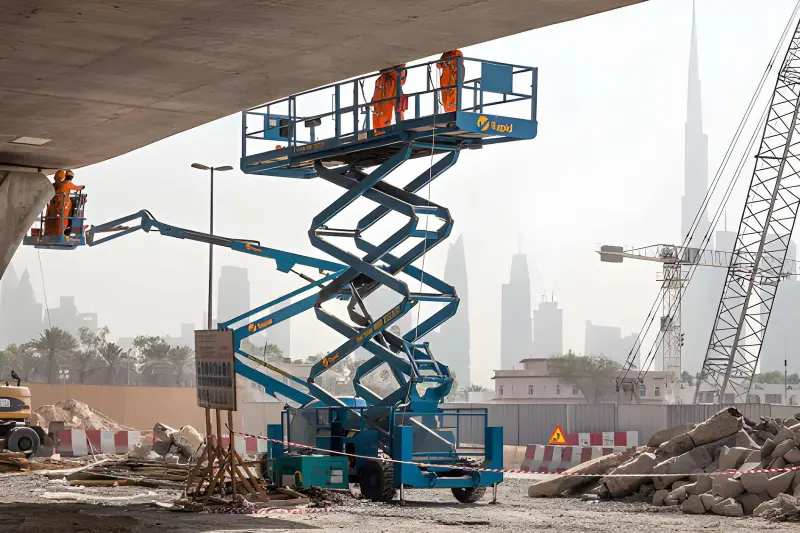
Scissor lifts provide large, stable platforms that elevate straight up. They don’t move horizontally—you position them before raising the platform.
Key advantages for HVAC:
- Spacious platform (accommodates 4–6 workers + materials)
- Very stable (better for sustained work)
- Excellent for main ductwork trunk line installation
- Good load capacity for multiple technicians working simultaneously
Limitation: No horizontal reach—can’t maneuver around obstacles or access specific ceiling points. Repositioning requires lowering platform, moving equipment, and raising again.
Best for: Large open areas, sustained work in one location, multiple simultaneous workers, primary ductwork installation.
Typical rental: AED 8,000–12,000 monthly
Vertical Mast Lifts
Compact vertical-only platforms reaching 6–10 metres. These fit confined spaces and doorways—essential for interior retrofit work.
Key advantages for HVAC:
- Ultra-compact (fit through standard doorways)
- Excellent for interior retrofit projects
- Good for ceiling maintenance access
- Lower cost than full-size booms
Limitation: Modest height and no horizontal reach—limited to vertical work only.
Best for: Interior retrofit HVAC maintenance, basement mechanical room access, confined commercial spaces.
Typical rental: AED 6,000–10,000 monthly
Comparing Equipment for HVAC Scenarios
New Construction—Primary Ductwork Installation
Work: Installing trunk ductwork runs from main HVAC unit to distributed zones across a 10-storey office building.
Equipment decision: Scissor lift or articulating boom (depending on ceiling complexity)
Why: Large platform accommodates ductwork sections and multiple technicians working together. Scissor lift works well in open ceiling voids. Articulating boom handles zones where structural complexity requires maneuvering.
Timeline: 4–6 weeks, cost AED 48,000–72,000 (scissor + boom combination)
Interior Unit Placement—Commercial Retrofit
Work: Installing ceiling-mounted indoor units across multiple floors in an existing building with constrained access.
Equipment decision: Articulating boom lift
Why: Units must position at precise ceiling points. Boom’s maneuverability reaches these locations. Scissor lift can’t maneuver around building structure and existing systems.
Timeline: 3–4 weeks, cost AED 36,000–54,000
Warehouse HVAC System Installation
Work: Installing high-bay ventilation, make-up air units, and ductwork in a 15-metre warehouse.
Equipment decision: Telescopic boom or high-reach scissor lift
Why: High reach matters. Open warehouse environment favours equipment with maximum vertical reach. No complex maneuvering needed.
Timeline: 2–3 weeks, cost AED 24,000–36,000
Maintenance Access—Facility Management
Work: Ongoing quarterly HVAC maintenance—filter changes, conduit cleaning, system inspections across multiple building levels.
Equipment decision: Vertical mast lift (if retrofit) or compact articulating boom (if various heights needed)
Why: Regular, mobile access across different areas. Vertical-only equipment sufficient for maintenance tasks. Compact equipment reduces facility disruption.
Annual cost: AED 120,000 (annual mast lift rental providing on-demand access)
Cost Analysis: Equipment Investment vs. Timeline Impact
Scenario: 12-Month HVAC Installation Project
Approach 1—Scaffolding (traditional method)
- Temporary scaffolding (installation, repositioning, removal): AED 120,000
- Extended timeline (scaffolding setup delays): 6+ additional weeks
- Additional labour overhead from delays: AED 60,000
- Total cost: AED 180,000+
Approach 2—Single scissor lift entire project
- Monthly rental (12 months): AED 10,000 × 12 = AED 120,000
- Faster timeline (no setup delays): 3–4 weeks compression
- Labour efficiency gains: AED 40,000
- Total cost: AED 80,000 (after efficiency gains)
Approach 3—Multi-equipment strategy (scissor for main work, boom for precision)
- Scissor lift (8 months): AED 80,000
- Articulating boom (4 months, precision finishing): AED 48,000
- Improved workflow through phase-specific equipment: AED 30,000 savings
- Total cost: AED 98,000
Winner: Multi-equipment approach provides optimal cost and timeline efficiency.
Safety and Compliance for HVAC Work
Working at Height Requirements
Dubai Municipality mandates fall protection for all work above 2 metres. Access equipment must meet specific safety standards:
- Regular inspections (quarterly for boom lifts, monthly for scissor lifts)
- Operator certification (MEWP training required)
- Load rating compliance (don’t exceed platform capacity)
- Secure guardrails and emergency descent systems
Scissor lifts and boom lifts have built-in safety features. Scaffolding requires additional harnesses and protection systems—adding complexity and cost.
Operator Training
MEWP operators require certification in Dubai. This training (typically 1 day, AED 500–800) ensures operators understand equipment limitations, safety procedures, and emergency protocols.
HVAC technicians don’t necessarily need MEWP certification—only the equipment operator does. However, worker familiarity with equipment safety improves overall site safety.
Common Mistakes in HVAC Access Equipment Selection
- Renting equipment without assessing ceiling complexity
Open ceiling voids suit scissor lifts. Complex structural ceilings require articulating booms. Selecting wrong equipment creates inefficiency. Visit the site before finalizing equipment selection.
- Underestimating material handling needs
HVAC work involves ductwork sections, refrigerant lines, and installation hardware. Platforms must accommodate materials, not just workers. Scissor lifts excel here; small lifts struggle with volume.
- Selecting based on day-rate cost without calculating project total
A scissor lift at AED 10,000/month for 8 months costs AED 80,000. A boom lift at AED 15,000/month for 6 months costs AED 90,000. Project total matters more than daily rates.
- Failing to plan phase transitions
HVAC projects move through phases (rough-in ductwork, unit placement, connections, testing). Different phases may suit different equipment. Plan equipment through all phases—not just initial ductwork.
- Overlooking maintenance access requirements
Post-installation, HVAC systems require ongoing maintenance. Equipment selection should consider whether future maintenance access is feasible. Vertical mast lifts or compact booms provide better permanent facility access.
Best Practices for HVAC Access Planning
Conduct site assessment 4–6 weeks before work begins. Understand ceiling heights, structural complexity, floor space, and obstruction locations. This assessment determines optimal equipment.
Create phase-specific equipment plans. Rough-in ductwork may suit scissor lifts; precision unit placement may need articulating booms. Plan equipment transitions between phases.
Calculate material handling requirements. How much ductwork, piping, and hardware will technicians carry? Ensure platform capacity accommodates expected load.
Confirm operator availability. MEWP operators must hold current certifications. Confirm availability for your project timeline before finalizing equipment selection.
Establish clear rental agreements. Define whether inspections, maintenance, fuel, and emergency support are included. Vague agreements create unexpected costs mid-project.
Plan for permanent maintenance access. After installation, HVAC systems need ongoing maintenance. Consider whether your access equipment choice supports future facility maintenance needs.
FAQ Section
Q1: Should HVAC contractors use boom lifts or scissor lifts? Both have roles. Scissor lifts excel for large-area ductwork installation with multiple workers and materials. Boom lifts excel for precision unit placement and constrained interior spaces. Many projects benefit from both equipment types in different phases.
Q2: Can boom lifts be used indoors for HVAC installation? Yes, articulating boom lifts work well indoors. They maneuver around structural columns and existing systems. However, confirm ceiling height (articulating booms need 12+ metres). Some older buildings have lower ceilings that restrict boom lift reach.
Q3: What’s the difference between articulating and telescopic boom lifts for HVAC work? Articulating booms bend around obstacles—better for complex interiors. Telescopic booms extend straight up—better for high-reach vertical work. Most indoor HVAC projects suit articulating booms. Warehouse/high-bay work suits telescopic booms.
Q4: Is a scissor lift better than scaffolding for HVAC installation? Yes. Scissor lifts are faster to deploy (no assembly), provide larger platforms (accommodate more workers and materials), include safety features (guardrails built-in), and cost less over typical HVAC project duration.
Q5: How do I know which lift height I need for my HVAC project? Measure your ceiling height and add 1–2 metres for comfortable working clearance above head. Most commercial interiors (3.5–4 metre ceilings) work with 6–8 metre lifts. High-bay facilities (8–15 metres) need larger reach equipment. Confirm specific ceiling heights before equipment selection.
Q6: Can multiple HVAC technicians work on one scissor lift platform? Yes. Scissor lift platforms typically accommodate 4–6 workers safely. However, crowded platforms reduce efficiency. Two technicians work better than six sharing one lift—better focus, safer working conditions.
Q7: What training do HVAC technicians need before working on access equipment? HVAC technicians don’t require formal MEWP operator certification—only the equipment operator does. However, site-specific orientation (equipment safety features, emergency procedures, platform load limits) before work begins improves overall safety.
Q8: Should HVAC contractors rent or buy access equipment? For most contractors, renting is more cost-effective. Purchase requires capital investment, maintenance responsibility, storage, and insurance. Renting provides flexibility without ownership burden. Contractors running simultaneous multiple projects might justify ownership economics.
Best Practices Summary
Right equipment selection depends on:
- Ceiling complexity (open vs. structural—affects boom vs. scissor decision)
- Work scope (ductwork area, unit count, installation phases)
- Material volume (how much equipment technicians carry—affects platform size)
- Project duration (affects rental economics)
- Future maintenance needs (should equipment support post-installation access)
HVAC contractors who plan equipment systematically complete projects faster and more cost-effectively than those who default to scaffolding or choose equipment reactively.
Conclusion
HVAC installation requires access equipment that supports mobility, precision positioning, and material handling. Scissor lifts, articulating boom lifts, telescopic booms, and vertical mast lifts each solve specific problems—and most complex projects benefit from combining multiple equipment types across different phases.
Cost isn’t just equipment rental. It includes project timeline impact, labour efficiency, material handling effectiveness, and future maintenance access. Lowest-cost equipment often isn’t most cost-effective when you account for total project impact.
The contractors executing HVAC installations most efficiently match access equipment to actual work requirements—not familiarity or convenience. Site assessment, phase-specific planning, and strategic equipment deployment deliver faster timelines, improved safety, and better cost control.
Planning HVAC installation for your next commercial project? Our team has supported hundreds of HVAC contractors with access equipment strategies optimized for ductwork installation, unit placement, and facility maintenance. We’ll help you assess your specific project requirements and recommend the right equipment combination. [Contact our HVAC access equipment specialists] to discuss your project and get a customized equipment plan.
HVAC Equipment Planning Checklist:
- Measure all ceiling heights and confirm reach requirements
- Assess ceiling complexity (structural obstacles, existing systems)
- Calculate ductwork volume and material handling needs
- Identify distinct project phases and equipment needs per phase
- Confirm operator availability and certifications
- Plan for post-installation facility maintenance access
- Compare total project cost across multiple equipment options